ISO 14001 training, consulting and certification services 

Comprehensive solutions for sustainable environmental management 

General Introduction to ISO 14001 

ISO 14001 is an international standard for Environmental Management System (EMS) issued by the International Organization for Standardization (ISO). This standard provides a legal framework and guidance to help organizations control and manage environmental aspects related to their operations, minimize adverse environmental impacts and improve resource efficiency. ISO 14001 not only brings intrinsic value in production and business activities but also contributes to increasing prestige and trust from stakeholders. 

Roles and benefits of ISO 14001 

  • Improve environmental management efficiency: ISO 14001 helps organizations build a transparent control system that ensures compliance with environmental laws and regulations. 
  • Reducing environmental risks: The application of this standard helps to identify, assess and control risks related to the environment, thereby minimizing incidents and unexpected damage. 
  • Increase business opportunities: ISO 14001 certification is a testament to our commitment to protecting the environment, thereby improving our corporate image and building trust with customers, partners and the community. 
  • Cost savings: Applying the ISO 14001 system helps optimize the use of raw materials and energy, reduce waste, and contribute to long-term operating cost savings. 
  • Legal compliance: Meeting the requirements of environmental laws helps businesses reduce the risk of fines, suspensions, or production interruptions. 
  • Motivation for innovation: Encourage businesses to continuously improve their processes, thereby improving the quality of products, services and reputation in the market. 

ISO 14001 Training Services 

Training is an important first step for organizations and businesses to understand the ISO 14001 standard as well as methods of building and operating an effective environmental management system. 

  • ISO 14001 awareness training: Provides basic knowledge about the standard, helping employees at all levels understand the role, meaning and requirements of ISO 14001 in practice. 
  • EMS system construction and operation training: Detailed instructions on how to build, implement, maintain and improve an environmental management system according to ISO 14001 requirements. 
  • Internal audit training: Equipping the team of internal auditors with skills to conduct inspections and evaluate the suitability, effectiveness and effectiveness of the system. 
  • Standard update training: Stay up to date with the latest changes in the ISO 14001:2015 version and related requirements. 

Training programs are often designed flexibly, suitable for the characteristics of each business, combining theory and practice to ensure that students apply to practical work. 

ISO 14001 Consulting Services 

ISO 14001 consulting is the process of supporting organizations to build, implement, maintain and improve environmental management systems in accordance with the characteristics and goals of each unit. The consultation process usually includes the following steps: 

  • Survey and assessment of the current situation: Consultants conduct analysis and assessment of the current environmental management situation, identify potential problems and risks. 
  • Planning to build the system: Based on the survey results, develop an implementation roadmap, determine the scope, objectives, environmental policies and control indicators. 
  • Support to build a document system: Support businesses to build a set of documents according to standard requirements, including environmental management manuals, processes, forms, and work instructions. 
  • Training and implementation guidance: Specific training and guidance for employees at departments on how to implement and operate the EMS system effectively. 
  • Internal assessment and remediation: Organize internal audits, detect non-conformities, propose remedial measures and continuous improvement. 
  • Support to prepare for certification audits: Support businesses to prepare documents, documents and necessary conditions to achieve good results in independent certification audits. 

Consulting services can be provided in full or in parts depending on the practical needs of the business. 

ISO 14001 Certification Services 

After the environmental management system is built and operated effectively, the next step is to register for an ISO 14001 certification audit by an independent, internationally recognized certification body. The certification process includes: 

  • Certification registration: Enterprises choose a reputable certification organization and submit an ISO 14001 certification registration dossier. 
  • Document evaluation: The certification body checks and evaluates whether the documentation system of the enterprise meets the requirements of ISO 14001 or not. 
  • Site Assessment: Experts perform on-site assessments at the business, inspecting operations, risk control, and regulatory compliance. 
  • Remediation and improvement: If a non-conformity is detected, businesses need to take corrective actions and report back to the certification body. 
  • Issuance of ISO 14001 certificate: After fully meeting the requirements, the enterprise is granted an ISO 14001 certificate of international validity. 
  • Periodic Monitoring: Once certified, the system will be monitored periodically (usually annually) to ensure conformity and effectiveness are maintained. 

Owning ISO 14001 certification is not only a testament to our commitment to the environment but also opens up many opportunities for international cooperation, participation in global supply chains and improving competitiveness. 

Reasons to choose ISO 14001 training, consulting, and certification services 

  • A team of experienced experts: Supporting businesses from identifying problems, building systems to obtaining certification in an efficient and time-saving way. 
  • Flexible approach: Services are designed according to actual needs, suitable for each type of business, from production, trade to service. 
  • Package or phased support: Meet different levels of needs, from initial consulting, personnel training, system building to certification assessment support, post-certification system maintenance. 
  • Optimize costs and resources: Help businesses choose the right solution, save time and costs while still ensuring efficiency. 
  • Information security: The information of the business is absolutely confidential throughout the cooperation process. 

ISO 14001 service implementation process 

The process of implementing ISO 14001 services is usually carried out according to the following basic steps: 

  • Receiving requests and surveying the business 
  • Assessment of the current status of the environmental management system 
  • Create a specific action plan, define goals and scope 
  • Awareness and in-depth training on ISO 14001 for managers and employees 
  • Develop and complete environmental management system documents 
  • Consulting, guiding the operation of testing and internal evaluation 
  • Assistance in fixing non-conformities (if any) 
  • Preparation and support for independent certification assessment 
  • Monitoring and maintaining the system after certification 

Commitment to accompany sustainable development 

ISO 14001 training, consulting and certification services are not only a solution to improve environmental management but also demonstrate social responsibility, build a green corporate image, towards sustainable development and international integration. The application of ISO 14001 is the key to unlocking long-term values, helping businesses quickly adapt to changes in the market, policies and increasingly stringent requirements on the domestic and global environment. 

If you are interested in ISO 14001 training, consulting or certification services, choose a reputable partner to accompany you on the road to building a sustainable, environmentally friendly and increasingly strong business! 

CONTACT FOR SERVICE SUPPORT:

Contact Vietnam representative: Duc Luong Services

Hotline: +84 933096426 – +84 868 591 260

Email: info.vietnam@iscglobal.asia – van.pham@iscglobal.asia – ducluongservices@gmail.com

REGISTER FOR SERVICE HERE: APPLICATION FORM!

ISCC Training, Consultancy and Certification Services 

Comprehensive solution for sustainable development and biomass supply chain 

About ISCC 

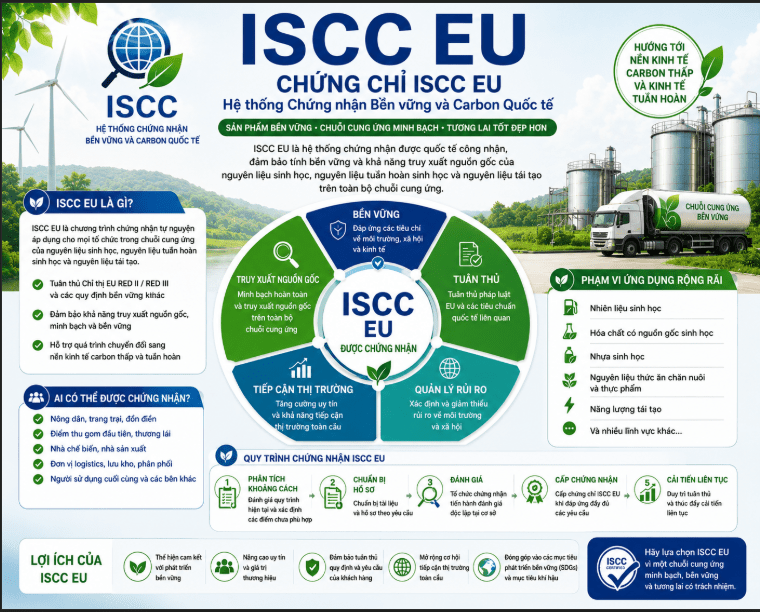
ISCC (International Sustainability and Carbon Certification) is a leading international certification system for sustainability, traceability and carbon emission reduction for biomass raw materials, recycled products, renewable energy and related fields. Established in 2010 in Germany, ISCC has become a widely recognized standard in more than 100 countries, helping businesses to make their operations transparent, ensure compliance with international regulations, and expand global markets. 

Why is ISCC important? 

ISCC not only helps businesses meet international legal standards on the environment, but also improves brand image, promotes sustainable development and creates a competitive advantage in the global market. Especially, for industries such as vegetable oil production, bioenergy, green chemicals, and the food and animal feed industry, ISCC certification is a necessary “passport” when exporting to Europe, the US, Japan and many other developed countries. 

ISCC Training Services 

Training objectives 

ISCC training services help organizations, businesses and individuals deeply grasp the principles, criteria and processes of implementation according to ISCC standards. The training aims to raise awareness, build a team of competent personnel to meet audit requirements, implement an effective management system and link throughout the entire supply chain. 

Training content 

  • An overview of ISCC and related certification systems 
  • Analysis of ISCC’s core standards: environmental, social, economic 
  • Traceability process and document management 
  • Risk assessment, identification of hot spots, and development of controls 
  • Practice of building an internal management system according to ISCC 
  • Prepare for internal and external audits 
  • Implement reporting and maintain certification 

Form of training 

  • In-house training 
  • Online training/via webinars 
  • Intensive training courses in each field: farms, factories, trade, logistics 
  • Training for management team, technical staff, operation staff 

ISCC Consulting Services 

Scope of consultation 

ISCC consulting services support businesses step by step to build, deploy and operate a management system in accordance with ISCC’s requirements. Consultants help determine the actual gap, propose a roadmap for improvement, and accompany the business until it achieves certification. 

Basic consultation steps 

  • Analysis of the current situation and assessment of the difference against the ISCC standard 
  • Develop internal processes, guidelines, and documents 
  • Personnel training and internal communication on ISCC 
  • Implementing measures to control, trace, protect the environment and society 
  • Supporting the preparation of documents for the certification audit 
  • Supervise and improve the management system after obtaining certification 

Benefits of using counseling services 

  • Shorten preparation time, reduce the risk of refusal of certification 
  • Optimize management processes, reduce operating costs 
  • Stay up-to-date with the latest requirements from ISCC and international regulations 
  • Connect with a global network of experts and businesses 

ISCC Certification Services 

Certification Process 

The ISCC certification process is carried out by ISCC accredited assessment bodies (Certification Bodies – CB). The typical process consists of 5 main steps: 

  • Evaluation of applications and service contracts 
  • Evaluation of documents and management systems of the enterprise 
  • Conduct field assessments, personnel interviews, and field operations inspections 
  • Analysis of results, recommendations for remediation (if any) 
  • Issue ISCC certification when the enterprise fully meets the requirements 

Subjects of application 

  • Farms and cooperatives cultivating biomass raw materials 
  • Factories producing and processing food, animal feed, biofuels 
  • Trade, import-export, logistics enterprises in the biomass supply chain 
  • Material recycling units, circular economy enterprises 

Benefits of achieving ISCC certification 

  • Affirming the commitment to sustainable development and environmental protection 
  • Improve reputation and brand with international partners, customers and investors 
  • Access to fastidious export markets such as the EU, US, Japan 
  • Prioritized in bidding and signing large contracts 
  • Meet legal requirements for carbon emission reduction, product traceability 
  • Contributing to reducing greenhouse gas emissions, preserving biodiversity and developing local communities 

ISCC training, consulting and certification services are a comprehensive solution to help Vietnamese businesses conquer international standards for sustainable development, increase competitiveness and expand the market. Investing in the ISCC management system not only brings economic benefits, but also affirms social responsibility, contributing to protecting the green planet for future generations. 

CONTACT FOR SERVICE SUPPORT:

Contact Vietnam representative: Duc Luong Services

Hotline: +84 933096426 – +84 868 591 260

Email: info.vietnam@iscglobal.asia – van.pham@iscglobal.asia – ducluongservices@gmail.com

REGISTER FOR SERVICE HERE: APPLICATION FORM!

Introduction to Vegan Standards 

Overview of The Vegan Society and the Vegan Trademark Certification System 

About The Vegan Society 

The Vegan Society is one of the pioneering organizations in the vegan movement in the world. Founded in 1944 in the United Kingdom, The Vegan Society is not only the origin of the term “vegan” but also the first organization to lay the foundation for the modern concept of vegan living. Since its inception, the organization has played a central role in promoting public awareness of the benefits of a vegan lifestyle for health, the environment, and animal rights. 

In 1990, The Vegan Society created the Vegan Trademark – a trademark that helps consumers identify vegan products quickly, conveniently and accurately. Since then, the Vegan Trademark has become the standard symbol for vegan products, recognized and trusted on a global scale. 

Vegan Trademark Core Definitions and Requirements 

According to the standards of The Vegan Society, products affixed with the Vegan Trademark must strictly meet the requirements of origin and production process: 

  • Do not use any products, by-products, or animal derivatives at any stage of product production and/or development. 
  • All ingredients, including additives, flavorings and preservatives, must be of plant or mineral origin. 

This strict control system is to ensure that products bearing the Vegan Trademark are fully in line with the vegan living philosophy, without affecting animals from the source of raw materials to the finished product. 

Detailed Certification Criteria 

1. Product ingredients 

Products that want to achieve Vegan Trademark certification must comply with the following strict criteria: 

  • Absolutely free of animal-derived substances such as meat, dairy, eggs, honey, gelatin and any additives of animal origin. 
  • All raw materials used must be plant-based or mineral, not of animal origin whether primary or secondary. 
  • Derivatives, synthetic flavors, enzymes, texturing agents… must also have a clear plant or mineral origin. 

2. Production Process 

The production and product development process is also a key factor in the approval of Vegan certification: 

  • No animal testing: Businesses may not conduct, authorize, or authorize any form of animal testing on the final product or any component of the product. This applies to both businesses and third parties over which the business has effective control. 
  • Cross-contamination control: Manufacturers must take reasonable and feasible measures to prevent and minimize the risk of cross-contamination between vegan products and non-vegan products/ingredients in the same production facility or production line. 
  • Traceability: The entire supply chain from raw materials to finished products must be transparent, allowing for traceability and periodic inspections. 

3. Quality Control and Evaluation Process 

To ensure the highest transparency and reliability, The Vegan Society conducts rigorous audits: 

  • Production Facility Audit: The organization will physically inspect the business’s factory, production line, and quality control system to ensure compliance with vegan standards. 
  • Considering the entire supply chain: Not only focusing on the final product, The Vegan Society also strictly controls from the source of raw materials, the process of storage, transportation, to packaging and distribution. 
  • Periodic inspection and re-evaluation: Enterprises need to maintain certification conditions and be ready to cooperate in periodic or irregular inspections and re-evaluations. 

Benefits of Vegan Trademark Certification 

1. International prestige 

Vegan Trademark is the world’s first professional vegan brand, with more than 30 years of experience in the field of vegan product authentication. Owning this trademark means that the business is positioned as a prestige in the global vegan community, serving customers with a strong sense of ethics, health and the environment. 

2. Brand identity and customer trust 

The Vegan Trademark logo has now become a sign of identification trusted and chosen by consumers around the globe. When the product carries this symbol, customers are easily aware and assured of quality standards, enhancing trust as well as competitiveness for businesses in the market. 

3. Expand export opportunities and develop markets 

In the context of developed markets such as Europe, North America, Oceania, and many Asian countries increasingly prioritizing eco-friendly and vegan products, Vegan certification opens up great opportunities for businesses to access and expand their export market share. 

4. Meet new consumer trends 

Modern customers, especially the younger generation, are increasingly interested in the origin and impact of products on animals, the environment and personal health. Owning Vegan certification helps businesses meet the increasing needs of this group of customers, while creating a sustainable competitive advantage. 

The Vegan Society’s Vegan Standard is a prestigious and objective certification system, aiming to protect animals, develop sustainably, and raise social awareness about vegan lifestyles. Strict compliance with the criteria of the standard not only contributes to building a business brand but also plays a positive role in changing consumption habits, protecting the environment and public health. 

With more than 30 years of establishment and development, Vegan Trademark has become a global symbol, a bridge between businesses and conscious consumers, contributing to spreading a humane and sustainable lifestyle for the present and the future. 

Vegan Standard Training, Consulting, and Certification Services 

A comprehensive solution for businesses towards sustainable development and meeting the trend of green consumption 

General Introduction to Vegan Standards 

The Vegan standard is not only a nutritional trend but also a new standard in modern manufacturing, business and lifestyle. Products or services that meet Vegan standards ensure that they do not use animal-derived ingredients, are not tested on animals, and adhere to strict principles of quality, safety, and ethics throughout the entire supply chain. Vegan certification is becoming increasingly important, especially as global consumers increasingly focus on health, the environment, and animal rights. 

The Importance of Vegan Training, Consulting, and Certification 

  • Consumer health protection: Vegan products are usually low in cholesterol, rich in fiber, and help reduce the risk of chronic diseases. 
  • Environmental protection: Vegan production helps reduce greenhouse gas emissions, save water, and reduce deforestation. 
  • Enhancing corporate social responsibility: Achieving Vegan certification demonstrates a company’s commitment to the community and sustainable development trends. 
  • Increase brand value: Products with Vegan certification easily reach international customers, especially in fastidious markets such as the EU, the US, and Canada. 

Vegan standard training services 

Vegan standard training is the first step to help businesses and organizations understand the requirements, processes and benefits when aiming for Vegan certification. The training program usually includes: 

  • An overview of Vegan and international standards: Help students grasp an overview of history, principles and prestigious certification organizations such as Vegan Society (UK), V-Label (Europe), Certified Vegan (USA)… 
  • Vegan production process analysis: Learn about raw materials, additives, processing, storage and packaging processes that meet Vegan standards. 
  • Quality Control and Prevention of Cross-contamination: Guidance on how to identify and eliminate animal hazards and contaminants during operation. 
  • Vegan Supply Chain Management: Training on supplier selection, ingredient control, and transportation to Vegan standards. 
  • Internal audit skills training and preparation of certification documents: Equip yourself with internal audit skills, process evidence and complete Vegan certification applications. 
  • Practice and handle situations: Simulate real-life situations for students to practice their ability to identify and solve problems related to Vegan standards. 

The training course can be designed flexibly and suitable for each subject: senior managers, production staff, quality control departments, product research and development departments, etc. 

Vegan Standard Consulting Service 

Vegan standard consulting plays a key role in helping businesses realize their certification goals in a time-saving, cost-effective and resource-saving way. The Vegan standard consultation process usually includes: 

  • Status survey and distance assessment: The consultant conducts a survey of the entire production process, from raw materials, processing lines to storage, packaging and distribution. 
  • Analyze and propose solutions: Advise on how to choose vegan ingredients, replace animal-derived additives, recommend options to optimize the production process. 
  • Support for building a Vegan quality management system: Propose to build processes, work instructions, and inspection forms in accordance with international Vegan standards. 
  • Internal personnel training: Organize in-depth training sessions for officers and employees on identifying, controlling risks and handling situations related to Vegan standards. 
  • Test and evaluation: Simulate the assessment process of the certification body so that businesses are familiar with the actual criteria and requirements. 
  • Support in preparing and completing Vegan certification applications: Advise on how to prepare documents and documents and coordinate with certification organizations throughout the inspection process. 
  • Accompanying after certification: Periodic consultation on maintaining and improving the Vegan management system and supporting the handling of problems that arise after being certified. 

Vegan Certification Services 

Vegan certification is authentic proof of compliance with international standards in the production, processing and sale of vegan products. Businesses need to pay attention to the following factors when applying for certification: 

  • Choose a reputable certification organization: Some globally recognized organizations such as Vegan Society, V-Label, Certified Vegan, Vegan Action… 
  • Prepare complete documents: Businesses need to provide documents related to the production process, the origin of raw materials, quality control processes, and evidence of animal exclusion. 
  • Meet physical inspection requirements: Certification bodies will conduct on-site inspections, evaluate processes, store product samples, and interview personnel directly. 
  • Compliance with traceability standards: Products must be traceable to clear raw materials, ensuring that there is no cross-contamination from animals. 
  • Maintenance and recertification: Vegan certification usually has a validity period of 1-3 years, businesses need to maintain and periodically re-evaluate at the request of the certification body. 

Vegan certification applies not only to food but also to cosmetics, home appliances, pharmaceuticals, personal care products, fashion and many other industries. 

Benefits of using Vegan training, consulting and certification services 

  • Access to the global market: Certified Vegan products easily enter the international market, improving export capabilities. 
  • Building trust with customers: Vegan labels are a guarantee to help customers rest assured about the quality and origin of products. 
  • Increased competitive advantage: Businesses can price higher than non-Vegan certified competitors. 
  • Meet the trend of green consumption: Vegan certification shows that the business keeps up with the trend of sustainability, contributing to the protection of the environment and animal rights. 
  • Minimizing legal risks: Incidents related to animal origin or cross-contamination will be strictly controlled according to international standards. 

The process of implementing Vegan training, consulting and certification services 

The service deployment process can be summarized as follows: 

  • Receive information and business needs. 
  • Survey the current situation and develop an appropriate training/consulting plan. 
  • Conduct professional training and organize practical counseling sessions. 
  • Support to complete documents, internal audits, and simulate certification evaluations. 
  • Accompanying businesses throughout the assessment process and after receiving the certificate. 

Vegan standard training, consulting and certification services are a comprehensive solution to help businesses not only meet strict requirements for quality and safety but also affirm their position in the international market. The application of Vegan standards not only brings economic benefits but also contributes to building an image of an environmentally friendly, socially responsible business and ready to accompany the green living trend of the modern world. 

CONTACT FOR SERVICE SUPPORT:

Contact Vietnam representative: Duc Luong Services

Hotline: +84 933096426 – +84 868 591 260

Email: info.vietnam@iscglobal.asia – van.pham@iscglobal.asia – ducluongservices@gmail.com

REGISTER FOR SERVICE HERE: APPLICATION FORM!

KHÓA ĐÀO TẠO NHẬN THỨC ISO 27001 –  HỆ THỐNG QUẢN LÝ THÔNG TIN (ISMS)

Mục Tiêu Khóa Học 

Khóa học nhận thức ISO 27001:2022 được thiết kế giúp học viên hiểu rõ: 

  • Mục đích, ý nghĩa và lợi ích của việc áp dụng hệ thống quản lý an ninh thông tin (ISMS). 
  • Cấu trúc, nội dung và các yêu cầu chính của tiêu chuẩn ISO 27001:2022. 
  • Cách thức áp dụng tiêu chuẩn vào thực tế để đảm bảo bảo mật, toàn vẹn và sẵn sàng của thông tin trong tổ chức. 
  • Vai trò và trách nhiệm của mỗi cá nhân trong việc duy trì an ninh thông tin. 

Đối Tượng Tham Gia 

Khóa học phù hợp với các đối tượng sau: 

  • Cán bộ, nhân viên các phòng ban có liên quan đến quản lý thông tin. 
  • Quản lý CNTT, quản lý chất lượng, an ninh thông tin. 
  • Người mới bắt đầu tìm hiểu ISO 27001. 
  • Doanh nghiệp chuẩn bị triển khai hoặc duy trì hệ thống ISMS. 

Nội Dung Chương Trình 

Module 1: Tổng Quan ISO 27001 

  • Khái niệm và mục đích của Hệ thống Quản lý An ninh Thông tin (ISMS). 
  • Vai trò của ISO 27001 trong việc bảo vệ dữ liệu và thông tin doanh nghiệp. 
  • Cấu trúc và nguyên tắc cơ bản của tiêu chuẩn (theo mô hình HLS). 

Module 2: Các yêu cầu chính của ISO 27001 

  • Các loại hình đánh giá ISMS (nội bộ, bên thứ hai, bên thứ ba) 
  • Bối cảnh tổ chức và các bên quan tâm. 
  • Lập kế hoạch đánh giá rủi ro và kiểm soát an ninh. 
  • Hỗ trợ: tài nguyên, năng lực, nhận thức, truyền thông và quản lý tài liệu. 
  • Vận hành và kiểm soát truy cập thông tin. 

Module 3: Chính sách và kiểm soát an ninh thông tin 

  • Giới thiệu các nhóm kiểm soát chính trong Phụ lục A (Annex A). 
  • Một số ví dụ thực tế về bảo mật dữ liệu, kiểm soát truy cập và xử lý sự cố. 

Module 4: Lợi ích của việc áp dụng ISO 27001 

  • Tăng cường bảo mật và độ tin cậy của hệ thống thông tin. 
  • Tuân thủ quy định pháp lý, yêu cầu của khách hàng và đối tác. 
  • Nâng cao uy tín doanh nghiệp, giảm thiểu rủi ro và thiệt hại. 

Phương Pháp Đào Tạo 

  • Hình thức: Trực tuyến (Online). 
  • Thời lượng: 1 buổi (khoảng 3 – 4 giờ). 
  • Phương pháp: Giảng giải kết hợp thảo luận, ví dụ thực tế và hỏi đáp. 

Kết quả đạt được sau Khóa Học 

  • Sau khi hoàn thành khóa học, học viên sẽ: 
  • Hiểu được khái niệm cơ bản về an ninh thông tin và ISO 27001. 
  • Nhận biết được các yêu cầu chính của tiêu chuẩn và vai trò cá nhân trong việc duy trì hệ thống ISMS. 
  • Có nhận thức rõ ràng hơn về tầm quan trọng của bảo vệ thông tin và cách tuân thủ quy trình nội bộ. 

Tại Sao Chọn ISC Global? 

Uy Tín và Kinh Nghiệm 

ISC Global là đơn vị đào tạo hàng đầu với nhiều năm kinh nghiệm trong lĩnh vực hệ thống quản lý. Với đội ngũ giảng viên là các chuyên gia có chứng chỉ quốc tế và kinh nghiệm thực tiễn phong phú, ISC Global cam kết mang đến chất lượng đào tạo cao nhất cho học viên.

Chương Trình Đào Tạo Chất Lượng 

  • Nội dung khóa học được thiết kế theo chuẩn quốc tế và cập nhật liên tục 
  • Phương pháp đào tạo hiện đại kết hợp lý thuyết và thực hành 
  • Môi trường học tập chuyên nghiệp và thân thiện 

Dịch Vụ Hỗ Trợ Toàn Diện 

  • Tư vấn miễn phí trước và sau khóa học 
  • Hỗ trợ kỹ thuật trong quá trình triển khai đánh giá thực tế 
  • Mạng lưới cựu học viên để chia sẻ kinh nghiệm 
  • Cơ hội tham gia các sự kiện và hội thảo chuyên ngành 

TIẾN TRÌNH TRIỂN KHAI 

  1. Gửi hóa đơn và thanh toán 100% trước đào tạo 
  1. Tổ chức lớp Online và cung cấp tài liệu 

Hình thức học: Online  

Thời gian học: 01 buổi vào sáng ngày 30/10/2025. 

CONTACT FOR SERVICE SUPPORT:

Contact Vietnam representative: Duc Luong Services

Hotline: +84 933096426 – +84 868 591 260

Email: info.vietnam@iscglobal.asia – van.pham@iscglobal.asia – ducluongservices@gmail.com

REGISTER FOR SERVICE HERE: APPLICATION FORM!

ISO 27001 AWARENESS TRAINING COURSE

Course Objectives

The ISO 27001:2022 awareness training course is designed to help students understand:

  • The purpose, significance, and benefits of implementing an Information Security Management System (ISMS).
  • The structure, content, and main requirements of ISO 27001:2022 standard.
  • How to apply the standard in practice to ensure confidentiality, integrity, and availability of information in organizations.
  • The role and responsibilities of each individual in maintaining information security.

Target Participants

The course is suitable for the following audiences:

  • Staff and employees of departments related to information management.
  • IT managers, quality managers, information security managers.
  • Beginners exploring ISO 27001.
  • Businesses preparing to implement or maintain ISMS systems.

Program Content

Module 1: ISO 27001 Overview

  • Concept and purpose of Information Security Management System (ISMS).
  • Role of ISO 27001 in protecting business data and information.
  • Structure and basic principles of the standard (according to HLS model).

Module 2: Main Requirements of ISO 27001

  • Types of ISMS assessments (internal, second-party, third-party)
  • Organizational context and interested parties.
  • Risk assessment and security control planning.
  • Support: resources, competence, awareness, communication, and document management.
  • Operations and information access control.

Module 3: Information Security Policies and Controls

  • Introduction to main control groups in Annex A.
  • Practical examples of data protection, access control, and incident handling.

Module 4: Benefits of Implementing ISO 27001

  • Enhance security and reliability of information systems.
  • Comply with legal regulations, customer and partner requirements.
  • Improve business reputation, minimize risks and losses.

Training Methods

  • Format: Online.
  • Duration: 1 session (approximately 3-4 hours).
  • Method: Lectures combined with discussions, practical examples, and Q&A.

Results Achieved After the Course

After completing the course, students will:

  • Understand basic concepts of information security and ISO 27001.
  • Recognize main requirements of the standard and individual roles in maintaining ISMS systems.
  • Have clearer awareness of the importance of information protection and how to comply with internal processes.

Why Choose ISC Global?

Reputation and Experience

ISC Global is a leading training organization with many years of experience in the management systems field. With a team of instructors who are experts with international certifications and rich practical experience, ISC Global is committed to providing the highest quality training for students.

Quality Training Program

  • Course content designed according to international standards and continuously updated
  • Modern training methods combining theory and practice
  • Professional and friendly learning environment

Comprehensive Support Services

  • Free consultation before and after courses
  • Technical support during practical implementation
  • Alumni network for experience sharing
  • Opportunities to participate in industry events and seminars

IMPLEMENTATION PROCESS

  1. Send invoice and receive 100% payment before training
  2. Organize online class and provide materials

Learning format: Online

Training time: 01 session on the morning of October 30, 2025.

CONTACT FOR SERVICE SUPPORT:

Contact Vietnam representative: Duc Luong Services

Hotline: +84 933096426 – +84 868 591 260

Email: info.vietnam@iscglobal.asia – van.pham@iscglobal.asia – ducluongservices@gmail.com

REGISTER FOR SERVICE HERE: APPLICATION FORM!

ISO 45001 TRAINING SERVICES 

General Introduction to ISO 45001 

ISO 45001 is the international standard for Occupational Health & Safety Management Systems (OHSMS) issued by the International Organization for Standardization (ISO). This standard provides a management framework and guidance to help organizations control and manage occupational safety risks, minimize accidents, occupational diseases, and protect worker health. 

ISO 45001 not only brings intrinsic value to production and business operations but also contributes to enhancing reputation, social responsibility, and trust from stakeholders. 

Role and Benefits of ISO 45001 

  • Improve safety management effectiveness: ISO 45001 helps organizations establish comprehensive management systems, ensuring compliance with occupational health and safety laws. 
  • Minimize accident risks: Identify, assess, and control hazards, limiting workplace incidents and occupational diseases. 
  • Increase business opportunities: ISO 45001 certification demonstrates commitment to protecting workers, enhancing corporate image with customers, partners, and investors. 
  • Cost savings: Reduce losses from accidents, reduce lost workdays, optimize insurance and healthcare costs. 
  • Legal compliance: Meet labor law and occupational safety and health requirements, reduce risk of penalties or production suspension. 
  • Innovation motivation: Encourage businesses to improve processes, enhance work efficiency and productivity. 

ISO 45001 Training Services 

Training is an important first step for businesses to understand the standard and implementation methods. 

  • ISO 45001 Awareness Training: Provide foundational knowledge about the standard, its role and practical significance. 
  • OHSMS Development & Operation Training: Guide development, implementation, maintenance, and improvement of safety management systems. 
  • Internal Auditor Training: Help internal audit teams develop skills to inspect and evaluate system conformity and effectiveness. 
  • Standard Update Training: Update latest changes to ISO 45001:2018 and related requirements. 

Training programs are designed flexibly, combining theory and practice, suitable for each business’s characteristics. 

ISO 45001 Consulting Services 

ISO 45001 consulting supports businesses in developing, implementing, maintaining, and improving occupational health and safety management systems. 

Consulting steps: 

  1. Current status survey and assessment: Analyze existing safety management systems, identify risks. 
  1. Implementation planning: Define scope, objectives, policies, and OHS programs. 
  1. Documentation system development: Support drafting OHSMS manuals, processes, forms, and guidelines. 
  1. Training & operational guidance: Directly train and support departments in implementation. 
  1. Internal audit & correction: Identify non-conformities, propose improvement measures. 
  1. Certification audit preparation: Support businesses in completing documents and preparing for independent assessment. 

ISO 45001 Certification Services 

After the OHSMS system is developed and operational: 

  1. Certification registration: Business submits documents to certification organization. 
  1. Document assessment: Check document conformity with ISO 45001 requirements. 
  1. On-site assessment: Experts evaluate actual operational processes, risk control, regulatory compliance. 
  1. Correction & improvement: Business addresses non-conformities (if any). 
  1. ISO 45001 certification issuance: Certificate with international validity. 
  1. Periodic surveillance: Usually annual, to ensure system maintains effectiveness. 

Reasons to Choose ISO 45001 Training, Consulting, and Certification Services 

  • Experienced expert team: Support businesses from problem identification, system development to achieving certification effectively and time-efficiently. 
  • Flexible approach: Services designed according to actual needs, suitable for various types of businesses, from manufacturing, commerce to services. 
  • Complete or phased support: Meet different levels of needs, from initial consulting, staff training, system development to certification assessment support and post-certification system maintenance. 
  • Cost and resource optimization: Help businesses choose appropriate solutions, save time and costs while ensuring effectiveness. 
  • Information confidentiality: Business information is kept strictly confidential throughout the cooperation process. 

ISO 45001 Service Implementation Process 

ISO 45001 service implementation process is typically carried out according to the following basic steps: 

  • After the OHSMS system is developed and operational: 
  • Certification registration: Business submits documents to certification organization. 
  • Document assessment: Check document conformity with ISO 45001 requirements. 
  • On-site assessment: Experts evaluate actual operational processes, risk control, regulatory compliance. 
  • Correction & improvement: Business addresses non-conformities (if any). 
  • ISO 45001 certification issuance: Certificate with international validity. 
  • Periodic surveillance: Usually annual, to ensure system maintains effectiveness. 

Commitment to Sustainable Development Partnership 

ISO 45001 training, consulting, and certification services are not only solutions to elevate occupational health and safety management but also demonstrate social responsibility, build modern corporate image, care for workers, and sustainable development. 

Implementing ISO 45001 is the key to helping businesses reduce risks, protect people, enhance competitiveness, and international integration

If your business is interested in ISO 45001 services, choose a reputable partner to accompany you on the journey of building a safe, effective, and sustainable work environment! 

CONTACT FOR SERVICE SUPPORT:

Contact Vietnam representative: Duc Luong Services

Hotline: +84 933096426 – +84 868 591 260

Email: info.vietnam@iscglobal.asia – van.pham@iscglobal.asia – ducluongservices@gmail.com

REGISTER FOR SERVICE HERE: APPLICATION FORM!

Introduction to the GRS Standard 

Learn about the Global Recycled Standard 

1. Overview of GRS standards 

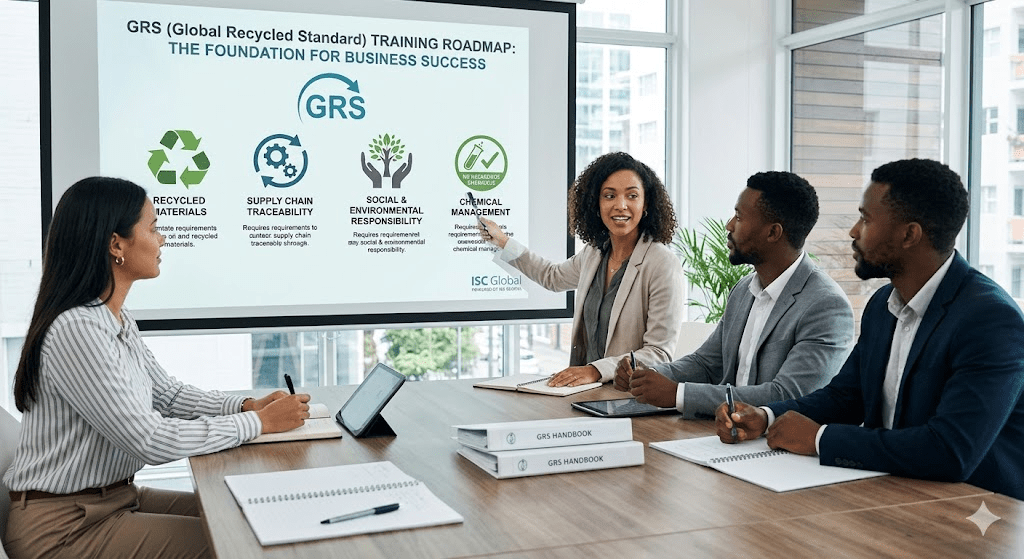
The GRS standard, which stands for Global Recycled Standard, is one of the most prestigious sets of international standards for products with recycled components. GRS was developed to meet the need to verify the origin, supply chain, and production processes of recycled products, and to encourage businesses to strengthen their social and environmental responsibility. 

2. Development history of GRS 

GRS was initiated by Control Union Certifications in 2008, then transferred to Textile Exchange – an international non-profit organization dedicated to promoting sustainable development in the textile industry. Through repeated reviews and improvements, the current GRS standard has expanded its scope of application, not only to the textile industry but also to include plastics, paper, metals and other recycled materials. 

3. Objectives of GRS Standards 

  • Verify the recycled content in the product, ensuring transparency about the origin of the material. 
  • Ensure environmentally friendly production processes, minimize negative impacts on the ecosystem. 
  • Promote safe and fair working conditions for employees. 
  • Manage and control hazardous chemicals throughout the supply chain. 

4. Scope of application of GRS 

The GRS standard applies to the entire supply chain, from the collection and sorting of recycled materials to the stages of production, packaging and transportation of the final product. Any business involved in one or more stages of this chain can apply for GRS certification, including raw material suppliers, fabric factories, textiles, dyeing, garments, packaging, etc. 

5. Main requirements of GRS standard 

5.1. Recycled components 

To achieve GRS certification, the product must contain a minimum of 20% recycled material. However, many brands and manufacturers aim higher, often 50% or more, to demonstrate a strong commitment to the environment. 

5.2. Chain of Custody 

GRS requires strict control of the journey chain of recycled materials from origin to finished product. This ensures that recycled materials are not blended with virgin materials or substandard substances throughout the production process. 

5.3. Environment 

GRS certified units must implement solutions to reduce waste, use water and energy resources sparingly, and efficiently treat exhaust gases, wastewater and solid waste. In addition, the use of hazardous chemicals is controlled or completely excluded from the production process. 

5.4. Social responsibility 

GRS requires businesses to comply with the criteria of employee rights: do not use child labor, forced labor; ensure safe and legal working conditions; implement full and transparent labor protection and salary and bonus regimes. 

5.5. Chemical requirements 

The GRS standard establishes a Restricted Substances List (RSL) to protect the health of consumers and workers, while ensuring that the final product is environmentally friendly. 

6. GRS Certification Process 

The GRS certification process includes the following basic steps: 

  • Enterprises register and submit dossiers for certification to accredited inspection organizations. 
  • Conduct a document assessment, production process and field at the facility. 
  • Inspection, sampling and inspection of recycled materials, chemicals, environmental and social conditions. 
  • Issue GRS certification when the enterprise fully meets the requirements. 
  • Certification has a term, usually 1 year and needs to be renewed and re-evaluated periodically. 

7. Benefits of GRS Certification 

  • Affirming the enterprise’s commitment to sustainable development and environmental protection. 
  • Increase transparency and prestige for products, easily access fastidious international markets. 
  • Help improve the efficiency of supply chain management and social responsibility. 
  • Supporting businesses to meet the legal regulations and expectations of modern consumers. 
  • Encourage innovation in the use of recycled materials, contributing to the reduction of greenhouse gas emissions. 

8. Challenges in applying GRS standards 

Although GRS brings a lot of value to businesses and society, the implementation also faces many difficulties: 

  • Investment costs for supply chain management and control systems and meeting high environmental and social standards. 
  • The requirement for transparency and tight control can require a lot of resources and expertise. 
  • Competition between enterprises that have not met the standards and have met the standards in terms of product costs. 
  • The challenge of collecting and sorting recyclables of uniform quality. 

The GRS standard has become an important tool to realize the goal of sustainable development in the modern manufacturing industry. The application of GRS not only helps businesses improve their brand image and increase competitiveness, but also contributes to building a circular economy, protecting the green planet for future generations. Therefore, GRS is being increasingly interested by businesses around the globe as well as in Vietnam, aiming to be a prestigious certificate for recycled products. 

CONTACT FOR SERVICE SUPPORT:

Contact Vietnam representative: Duc Luong Services

Hotline: +84 933096426 – +84 868 591 260

Email: info.vietnam@iscglobal.asia – van.pham@iscglobal.asia – ducluongservices@gmail.com

REGISTER FOR SERVICE HERE: APPLICATION FORM!

INTRODUCTION TO ISO 45001 STANDARD 

Concept of ISO 45001 

ISO 45001 is an international standard defining requirements for Occupational Health & Safety Management Systems (OHSMS). This standard provides a framework to help organizations identify, control, and minimize occupational safety risks, occupational diseases, and negative impacts on worker health. 

By implementing ISO 45001, organizations not only ensure compliance with occupational safety laws but also demonstrate commitment to workers, customers, and communities in creating safe and healthy work environments. 

Development History of ISO 45001 

  • Before ISO 45001, many businesses applied OHSAS 18001 standard. 
  • On March 12, 2018, ISO announced ISO 45001:2018, officially replacing OHSAS 18001. 
  • ISO 45001 was built on high-level structure (HLS) for easy integration with other management systems such as ISO 9001 (quality) and ISO 14001 (environment). 

Why is ISO 45001 Important? 

Implementing ISO 45001 brings many important benefits: 

  • Legal compliance: Helps businesses meet legal requirements for occupational health and safety. 
  • Reduce accident and occupational disease risks: Identify, control, and prevent hazards in production and business operations. 
  • Cost savings: Limit losses from workplace accidents, reduce lost workdays, optimize insurance and healthcare costs. 
  • Enhance reputation and image: Organizations demonstrate responsibility to workers and society, gain advantages in cooperation and bidding. 
  • Attract customers, partners, and investors: Many stakeholders prioritize working with businesses with ISO 45001 certification. 
  • Sustainable development: Ensure balance between business growth and social welfare. 

Basic Principles of ISO 45001 Management System 

ISO 45001 is built on modern quality management principles, especially the PDCA (Plan-Do-Check-Act) model, including: 

  • Plan: Identify hazards, assess risks, define OHS objectives and action plans. 
  • Do: Implement processes, risk control measures, safety programs. 
  • Check: Monitor, measure, evaluate implementation, identify deviations and improvement opportunities. 
  • Act: Implement corrective actions and improve safety management system effectiveness. 

Basic Requirements in ISO 45001:2018 

ISO 45001:2018 standard is structured into multiple clauses, with main requirements including: 

  • Organization context: Understand internal and external factors affecting OHSMS. 
  • Leadership & commitment: Top leadership role in directing, supporting, and committing to safety. 
  • Planning: Identify hazards, assess risks, determine opportunities and OHS objectives. 
  • Support: Ensure resources, competence, training, communication, and system documentation. 
  • Operation: Operational control, change management, emergency preparedness & response. 
  • Performance evaluation: Monitoring, measurement, internal audit, management review. 
  • Improvement: Correct non-conformities, continuous improvement. 

ISO 45001 Implementation Process at Businesses 

To successfully implement ISO 45001, businesses typically perform the following main steps: 

  • Survey & assess current safety system status. 
  • Establish safety policy, objectives, and OHS programs. 
  • Awareness training, responsibility assignment, risk management process development. 
  • Trial system operation, conduct internal audit & management review. 
  • Correct non-conformities and prepare certification documents. 
  • Certification assessment by independent organization and maintenance through periodic surveillance. 

Notable Changes in ISO 45001:2018 

The 2015 version of ISO 45001 has several new features compared to previous versions, notably: 

  • Apply high-level structure (HLS) — easy integration with ISO 9001, ISO 14001. 
  • Strengthen leadership role, safety commitment from highest level. 
  • Focus on risk-based thinking and opportunities in OHS management. 
  • Expand scope to entire operational chain, including contractors and partners. 
  • Encourage broad worker participation in management system. 

Outstanding Benefits of Implementing ISO 45001 

  • Protect people: Minimize accidents, injuries, occupational diseases. 
  • Protect business: Reduce production disruptions, limit arising costs and litigation. 
  • Increase competitiveness: Enhance reputation, facilitate market expansion. 
  • Sustainable development: Modern corporate image, socially responsible, promoting safe and civilized work environment. 

ISO 45001 is an effective management tool for organizations and businesses to ensure safety, comply with laws, improve operational efficiency, and affirm social responsibility on the sustainable development journey. 

CONTACT FOR SERVICE SUPPORT:

Contact Vietnam representative: Duc Luong Services

Hotline: +84 933096426 – +84 868 591 260

Email: info.vietnam@iscglobal.asia – van.pham@iscglobal.asia – ducluongservices@gmail.com

REGISTER FOR SERVICE HERE: APPLICATION FORM!

Introduction to ISO 14001 

International Environmental Management System 

ISO 14001 is one of the most important international standards for environmental management, developed and issued by the International Organization for Standardization (ISO). With the goal of guiding organizations and businesses to build, operate and maintain an effective environmental management system, ISO 14001 has become the foundation for sustainable development and environmental protection on a global scale. 

Concept of ISO 14001 

ISO 14001 is an international standard that defines the requirements for an Environmental Management System (EMS). This standard provides a framework to help organizations identify, control and mitigate the negative impacts of production and business activities on the environment. By applying ISO 14001, the organization not only complies with environmental laws and regulations, but also demonstrates its commitment to the community and its customers in terms of environmental responsibility. 

History of ISO 14001 

ISO 14001 was first published in 1996, meeting the increasing requirements for environmental protection in production and business activities. Through many revisions and updates, the current version of the standard is ISO 14001:2015, issued in September 2015. This edition focuses on risk-based thinking, the involvement of senior leadership, and a closer alignment between the environmental management system and the overall business strategy of the organization. 

Why is ISO 14001 important? 

The application of ISO 14001 brings many important benefits to the organization, the community and the environment: 

  • Legal compliance: Organizations ensure compliance with environmental regulations and laws at both the national and international levels. 
  • Reducing environmental risks: Identifying, controlling and preventing negative impacts on the environment. 
  • Cost-saving: Reasonable use of raw materials, reducing the amount of waste, saving energy and pollution treatment costs. 
  • Improve reputation and image: Enterprises applying ISO 14001 will create an image of social responsibility and increase competitiveness in the market. 
  • Attracting customers and partners: Many partners, investors, and customers prioritize choosing businesses with environmental management systems that meet international standards. 
  • Supporting sustainable development: Ensuring a balance between economic development and environmental protection. 

Basic principles of the environmental management system according to ISO 14001 

ISO 14001 is built on modern quality management principles, especially the PDCA (Plan-Do-Check-Act) model, including: 

  • Plan: Identify environmental goals, processes, and resources needed, and make an action plan to achieve the set goals. 
  • Due (Implemented): Implementing specific processes, programs, and actions to control environmental impacts. 
  • Check: Measure, monitor and evaluate the effectiveness of environmental management activities, identify strengths, weaknesses and improvements. 
  • Act (Improvement Action): Implement improvement measures based on the results of the assessment, ensuring the continuous improvement of the environmental management system. 

Basic requirements in ISO 14001:2015 

The ISO 14001:2015 standard is structured into several clauses, of which the main requirements include: 

  • Organizational background: Understand internal and external issues affecting the environmental management system. 
  • Leadership and commitment: Participation and support of senior leaders in building, operating and improving EMS. 
  • Planning: Identifying risks, opportunities, objectives, and environmental management programs. 
  • Support: Securing resources, training, awareness, information exchange, and document management. 
  • Implementation: Implement operational control processes, be ready to respond to environmental emergencies. 
  • Performance Evaluation: Monitor, measure, analyze, and evaluate the implementation of environmental objectives. 
  • Improvement: Regularly carry out improvement activities to improve the efficiency of the environmental management system. 

ISO 14001 implementation process at enterprises 

To successfully apply ISO 14001, businesses usually take the following main steps: 

  • Survey, assess the current situation and identify environmental factors related to production and business activities. 
  • Establish environmental policies, specific goals, and develop action programs. 
  • Assign responsibilities, train awareness, develop environmental impact control and assessment processes. 
  • Conduct internal audits, review by leaders and make continuous improvements. 
  • Prepare all documents and conduct certification assessments by independent certification bodies. 

Notable changes to ISO 14001:2015 

The 2015 version of ISO 14001 has a number of new features compared to previous versions, notably such as: 

  • More robust integration with other management standards such as ISO 9001. 
  • Emphasizing the leadership role, ensuring environmental management responsibility at the highest level. 
  • Strengthen the assessment of risks and opportunities related to the environment. 
  • Expand the scope of environmental impact consideration throughout the entire life cycle of products and services. 
  • Encourage stakeholder involvement in the development, implementation, and monitoring of the EMS. 

Outstanding benefits of applying ISO 14001 

The successful application of ISO 14001 not only helps organizations effectively manage environmental impacts but also brings many specific benefits such as: 

  • Minimizing waste, saving resources (water, electricity, fuel, raw materials…) 
  • Reduce the cost of pollution treatment, waste management, and improve asset efficiency. 
  • Improve competitiveness and facilitate the expansion of export markets. 
  • Increase customer satisfaction, community, and stakeholders. 
  • Reduce the risk of being sanctioned for violating environmental regulations. 

ISO 14001 is an effective management tool for organizations and businesses in the process of sustainable development, both ensuring business efficiency and protecting the living environment. The application of this standard is becoming more and more urgent, contributing to building a modern, socially responsible corporate image and towards a sustainable green future. 

CONTACT FOR SERVICE SUPPORT:

Contact Vietnam representative: Duc Luong Services

Hotline: +84 933096426 – +84 868 591 260

Email: info.vietnam@iscglobal.asia – van.pham@iscglobal.asia – ducluongservices@gmail.com

REGISTER FOR SERVICE HERE: APPLICATION FORM!

Introduction to ISCC Standards 

Global Sustainability Certification System for Supply Chain 

ISCC (International Sustainability and Carbon Certification) is one of the leading international certification systems for sustainability and traceability in the supply chain of biomaterials, renewable energy and agricultural products. Designed to meet the stringent requirements of the global market, the ISCC standard is increasingly becoming an integral part of businesses working towards sustainable development and meeting environmental regulations in many countries. 

1. History of ISCC 

ISCC has been developed and implemented since 2010 in Germany, in collaboration with many leading European organizations, associations, businesses and scientists. Initially, this system was born to meet the requirements for sustainable development under the Renewable Energy Directive (RED) of the European Union. However, to date, ISCC has expanded its global scope of application and is recognized in many regions such as the Americas, Asia, Africa and Australia. 

2. ISCC’s Purpose and Core Values 

ISCC’s main goal is to ensure that raw materials, products, and supply chains meet strict criteria for environmental protection, sustainable development, greenhouse gas emission reduction, and respect for social rights. This system not only helps businesses improve brand value but also creates trust for partners, investors and consumers. 

  • Transparency of origin and supply chain. 
  • Minimize negative impacts on the environment and climate. 
  • Promote sustainable agricultural and industrial development. 
  • Protect the rights of workers and local communities. 

3. Types of ISCC certification 

ISCC currently has two main certification systems: 

  • ISCC EU: Accredited under the EU Renewable Energy Directive, applicable to products and biomaterials exported to the European market, focusing on reducing greenhouse gas emissions and protecting biodiversity. 
  • ISCC PLUS: Applicable to the global market, not limited by EU regulations. ISCC PLUS is often used for non-fuel products such as food, animal feed, chemicals, packaging materials, bioplastics, etc. 

In addition, ISCC also has ancillary standards related to the fields of energy, by-products, recycling, biomass from waste and by-products, promoting the circular economy. 

4. ISCC Fundamentals 

ISCC is based on 6 foundational principles: 

  • Conservation of high-value soils for biodiversity or carbon stocks (e.g., primary forests, peatlands, wetlands, etc.) raw materials must not be exploited). 
  • Sustainable production practices (reducing the use of toxic chemicals, optimizing irrigation water, ensuring labor safety, conserving land and water resources). 
  • Protect the natural environment (do not destroy forests, do not encroach on sensitive lands). 
  • Protection of social rights (prevention of forced labor, ensuring fair working rights and conditions for employees). 
  • Comply with international laws and regulations. 
  • Supply chain control and transparency (traceability of raw materials from origin to final finished product). 

5. ISCC Certification Process 

To achieve ISCC certification, an organization/business needs to take the following steps: 

  • Register for certification with the ISCC Organization or its representative in the host country. 
  • Prepare relevant documents and documents on policies, production processes, quality management, personnel records, environment, etc. 
  • Conduct internal audits and improve the remaining limitations (if any). 
  • Independent third-party testing and evaluation organizations that have been accredited by ISCC. 
  • Report on the results of assessment and remediation of inappropriate scores (if any). 
  • Receive a valid ISCC certificate if you meet all the requirements. 
  • Maintain certification through periodic inspections, continuous monitoring, and innovation and improvement of production processes. 

6. Benefits to businesses and society 

Businesses that achieve ISCC certification will receive many great benefits: 

  • Increase opportunities to access international markets, especially the EU. 
  • Trusted and chosen by partners and customers in sustainable supply chains. 
  • Optimize production costs thanks to an efficient management process, reducing resource waste. 
  • Limit legal risks related to the environment and labor. 
  • Contributing to environmental protection, community development and raising the national brand. 

7. Practical application of ISCC in Vietnam and the world 

In Vietnam, ISCC has been applied by many enterprises in the fields of agricultural production, food processing, energy (especially the production of biofuels from sugarcane, bagasse, palm oil, corn, cassava, etc.), chemicals, plastics and packaging to increase global competitiveness. ISCC certified products often have a high export value and are prioritized in international transactions. 

Around the world, ISCC is present in more than 100 countries, tens of thousands of certified businesses and organizations, contributing to the formation of sustainable supply chains throughout the globe, from raw materials to final products. 

8. Challenges and opportunities in the application of ISCC 

Achieving ISCC certification requires businesses to invest heavily in upgrading processes, technology, training human resources and changing the perception of sustainable development. However, this is also a great opportunity for Vietnamese businesses to improve their position in the international market, access green capital and cooperate with major partners. 

The ISCC standard is not only a “passport” for businesses in the global supply chain but also a long-term commitment to sustainable development, environmental protection and community. The application of ISCC is an inevitable trend to realize green goals, improve the position of Vietnamese brands in the international arena and towards a sustainable future for both the economy and society. 

CONTACT FOR SERVICE SUPPORT:

Contact Vietnam representative: Duc Luong Services

Hotline: +84 933096426 – +84 868 591 260

Email: info.vietnam@iscglobal.asia – van.pham@iscglobal.asia – ducluongservices@gmail.com

REGISTER FOR SERVICE HERE: APPLICATION FORM!