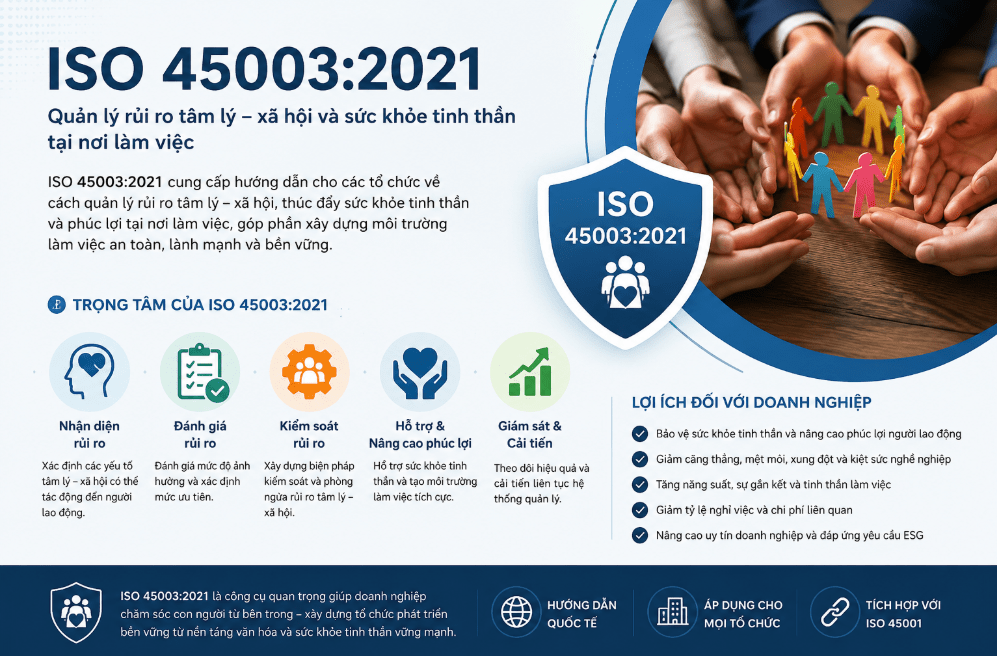
In the post-pandemic era, where work pressure, burnout, and psychological issues have become major challenges to business performance, ISO 45003 has emerged as a groundbreaking solution. This is not just a technical guidance document—it is a commitment from businesses to create a happy, safe, and humane working environment.
This article will help you understand what ISO 45003 is, the psychosocial risks that need management, the practical benefits, and the roadmap for implementing this standard within your organization.
1. What is the ISO 45003 Standard?
ISO 45003:2021 is the first international standard providing guidance on managing psychosocial risks within an Occupational Health and Safety (OH&S) management system. It serves as a supplementary standard to ISO 45001 (Occupational Health and Safety Management Systems).
Instead of focusing on physical injuries (falls, electric shocks, fires), ISO 45003 focuses on “invisible injuries”: stress, anxiety, depression, and workplace bullying. This standard guides businesses on how to identify hazards that can affect employees’ mental health and provides effective control measures.
The Scope of ISO 45003 covers:
- How work is organized: Workload, deadlines, and autonomy.
- Social factors at work: Company culture, peer relationships, and leadership style.
- Work environment and equipment: Lighting, noise, space, and tools.
2. Psychosocial Risks According to ISO 45003
ISO 45003 categorizes psychosocial risks into three main groups that businesses should pay close attention to:
2.1. Work Organization
- Excessive or insufficient workload.
- Lack of control or decision-making power over one’s work.
- Inflexible work schedules leading to poor work-life balance.
2.2. Social Factors at the Workplace
- Lack of support from supervisors and colleagues.
- Isolation, bullying, or harassment.
- Lack of fair recognition and rewards.
- Role ambiguity or job insecurity.
2.3. Work Environment and Equipment
- Poor working conditions (cramped spaces, lack of privacy).
- Inadequate or malfunctioning equipment causing long-term frustration.
3. Benefits of Implementing ISO 45003
Investing in mental health according to ISO 45003 standards brings clear economic and brand value:
3.1. Reduced Turnover and Absenteeism
Stress is a leading cause of sick leave and resignations. Managing psychosocial risks effectively helps minimize recruitment and retraining costs for new personnel.
3.2. Enhanced Productivity and Creativity
Employees who are psychologically stable and feel respected tend to be more committed, think more creatively, and make fewer errors in their work.
3.3. Building a Sustainable Corporate Culture
ISO 45003 fosters a workplace based on trust and mutual support, thereby increasing Employee Engagement scores.
3.4. Enhanced Reputation and ESG Branding
In ESG (Environmental, Social, and Governance) reporting, employee mental health is a key indicator. Achieving this standard helps businesses gain points with international investors and partners.
4. Implementation Roadmap for ISO 45003
Step 1: Leadership Commitment
Top management must understand and commit resources to mental health. Without high-level consensus, implementation will remain superficial.
Step 2: Identification of Psychosocial Risks
Use anonymous surveys, focus group interviews, or turnover data analysis to find “hotspots” causing stress for employees.
Step 3: Action Planning
Design interventions such as restructuring work processes, establishing anti-bullying policies, or providing Employee Assistance Programs (EAPs).
Step 4: Implementation and Training
Organize workshops on stress management, train managers in active listening skills, and promote psychological support channels within the company.
Step 5: Evaluation and Improvement
Measure effectiveness after a period of implementation (e.g., 6 months) based on employee feedback and changes in absenteeism rates to make necessary adjustments.
5. Comparison: ISO 45003 vs. ISO 45001
| Criteria | ISO 45001 | ISO 45003 |
| Nature | Certification Standard (Requirements) | Guidance Standard (Recommendations) |
| Focus | General Occupational Health & Safety | Mental Health & Psychosocial Factors |
| Objective | Preventing physical injury | Preventing psychological harm |
| Approach | Controls physical, chemical, biological risks | Controls culture, management, and organization |
| Relationship | The Foundation | An advanced extension of ISO 45001 |
6. Frequently Asked Questions (FAQ)
6.1. Can a business receive a standalone ISO 45003 certificate?
Since ISO 45003 is a guidance standard, organizations typically evaluate compliance with ISO 45003 as part of an ISO 45001 audit. However, you can still receive a “Statement of Compliance” from auditing bodies.
6.2. Is ISO 45003 suitable for remote work?
Absolutely. In fact, remote work often harbors hidden psychological risks such as isolation and the blurring of boundaries between work and home. ISO 45003 provides an excellent management framework for these models.
6.3. Is the implementation cost high?
Most costs are not in equipment but in training time and shifting management mindsets. This is an investment with a high ROI (Return on Investment) due to the reduction in loss of top talent.
7. Conclusion – Investing in People is the Most Sustainable Investment
In the future, the strength of a business will not just be measured by machinery or technology, but by the psychological resilience of its workforce. ISO 45003 is the “compass” for businesses to realize this.
Applying ISO 45003 is not about turning the office into a therapy room; it is about building a smarter operational system where every individual feels safe to give their best.
Contact us for ISO 45003 Implementation Consultancy
If your business wants to lead the way in caring for employee mental health according to international standards, contact us for a detailed roadmap.
Business Consultation & Support Contact:
Hotline: +84 933096426 – +84 868 591 260
Email:
Website:
Strategic Partners in Vietnam:
Contact Vietnam representative: Duc Luong Services
Hotline: +84 933096426 – +84 868 591 260
Email: ducluongservices@gmail.com
Website:
STC VN Co., Ltd.
Hotline: +84 933096426 – +84 868 591 260
Email: info@staunchlyservices.com.vn
Website: https://stauchlyservices.com.vn
Duc Luong Services | Your Trusted Partner. Effective Implementation.

