As global supply chains increasingly prioritize transparency and human rights, SA 8000 has become the gold standard for businesses to demonstrate their commitment to fair working conditions. This is not just a human resources certificate—it is concrete evidence of ethical business practices, protecting labor rights, and enhancing brand reputation on the international stage.
This article will help you understand what SA 8000 is, its core requirements, practical benefits for businesses, and the detailed process to achieve this prestigious certification in Vietnam.
1. What is the SA 8000 Standard?
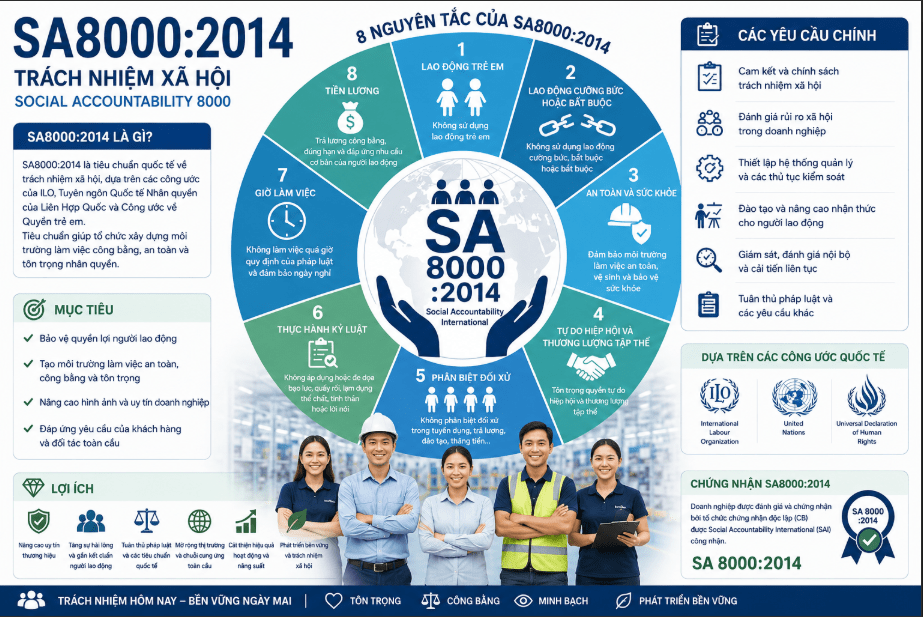
SA 8000 (Social Accountability 8000) is the world’s leading social certification program. It provides a framework for organizations of all types, in any industry, and in any country to demonstrate their dedication to the fair treatment of workers. Established in 1997 by Social Accountability International (SAI), it was the first auditable social standard.
SA 8000 is based on International Labour Organization (ILO) conventions, the Universal Declaration of Human Rights, and UN conventions.
The Core Pillars of SA 8000:
- Workers’ Rights: Protecting the dignity and freedom of employees.
- Work Environment: Ensuring a safe, hygienic, and healthy workplace.
- Management Systems: Establishing control processes to maintain sustainable compliance.
2. The Core Requirements of SA 8000
Unlike Travelife, which is divided into progressive levels, SA 8000 consists of 9 key requirements that businesses must strictly adhere to:
- Child Labor: Prohibition of hiring workers under the legal minimum age.
- Forced or Compulsory Labor: No use of prison labor, bonded labor, or withholding original identity documents.
- Health and Safety: Providing a safe work environment with clean water, adequate sanitation, and necessary protective equipment.
- Freedom of Association & Right to Collective Bargaining: Respecting the right of workers to form unions and negotiate.
- Discrimination: No discrimination based on gender, religion, race, or political views in hiring and promotion.
- Disciplinary Practices: Prohibition of corporal punishment, mental or physical coercion, or verbal abuse.
- Working Hours: Compliance with laws on maximum working hours (usually 48 hours/week plus 12 hours overtime) and ensuring at least one day off every six days.
- Remuneration: Wages must meet legal minimum standards and be sufficient to meet the basic needs of workers and their families.
- Management System: Documenting procedures, conducting risk assessments, and monitoring the supply chain.
3. Benefits of Achieving SA 8000 Certification
Earning an SA 8000 certificate provides significant strategic value:
3.1. Competitive Advantage in Global Supply Chains
Major global corporations (such as Walmart, Adidas, Nike, etc.) prefer or mandate that suppliers hold SA 8000 certification to mitigate brand risks associated with labor scandals.
3.2. Reduced Legal Risks and Costs
Strict compliance helps businesses avoid fines for labor law violations and reduces workplace accidents and strikes that cause production downtime.
3.3. Attracting and Retaining Talent
A fair working environment with transparent compensation helps retain skilled workers, reducing turnover rates and recruitment costs.
3.4. Enhanced Productivity and Quality
Workers in a safe and respectful environment tend to have higher morale, leading to increased efficiency and better product quality.
4. The Process to Achieve SA 8000 in Vietnam
Step 1: Application and Gap Analysis
The business selects an SAI-accredited certification body. A preliminary survey is conducted to identify gaps between current practices and SA 8000 requirements.
Step 2: System Development and Training
- Establish a Social Performance Team (SPT).
- Draft social responsibility policies and documentation.
- Conduct awareness training for all employees.
Step 3: Implementation and Internal Audit
Apply the processes in reality (e.g., installing fire safety equipment, renewing labor contracts, reviewing payroll). Then, conduct an internal audit.
Step 4: Formal Certification Audit
Auditors from the certification body will visit the site to:
- Inspect personnel records and payroll.
- Conduct confidential and random interviews with workers.
- Verify safety conditions on the production floor.
Step 5: Corrective Actions and Certification
If non-conformities (NCs) are found, the business must implement corrective actions. Once requirements are met, the SA 8000 certificate is issued with a 3-year validity.
Step 6: Surveillance Audits
Every 6 to 12 months, the certification body will conduct surveillance audits to ensure the business continues to maintain the committed standards.
5. SA 8000 vs. Other Social Responsibility Standards
| Criteria | SA 8000 | BSCI (Amfori) | WRAP | ISO 26000 |
| Type | Certification | Audit System | Certification | Guidance |
| Target Industry | All Industries | Primarily Retail/Consumer | Apparel/Footwear | All Organizations |
| Audit Type | Independent 3rd Party | Independent 3rd Party | Independent 3rd Party | Self-declared |
| Legal Weight | Very High | Popular in EU | Popular in USA | Framework only |
| Validity | 3 Years | 1 – 2 Years | 6 months – 2 years | N/A |
6. Frequently Asked Questions (FAQ)
6.1. How much does SA 8000 certification cost?
The cost depends on the size of the company, consultancy fees, and audit fees. For Vietnamese SMEs, the largest investment often goes toward upgrading occupational safety equipment.
6.2. How long does it take to get certified?
Typically 6 to 12 months, depending on the readiness of the current management system.
6.3. Can a company with fewer than 50 employees apply?
Yes. SA 8000 does not discriminate by size; what matters is the ability to comply with human rights and labor requirements.
7. Conclusion: A Strategic Investment for the Future
SA 8000 is more than just a “passport” for exporting goods. it is a declaration of a modern business mindset: Success is tied to the well-being of the workforce. In an era of conscious consumption, SA 8000 will be the sharpest tool for Vietnamese enterprises to stand firm in the global value chain.
Business Consultation & Support Contact:
Hotline: +84 933096426 – +84 868 591 260
Email:
Website:
Strategic Partners in Vietnam:
Contact Vietnam representative: Duc Luong Services
Hotline: +84 933096426 – +84 868 591 260
Email: ducluongservices@gmail.com
Website:
STC VN Co., Ltd.
Hotline: +84 933096426 – +84 868 591 260
Email: info@staunchlyservices.com.vn
Website: https://stauchlyservices.com.vn
Duc Luong Services | Your Trusted Partner. Effective Implementation.

