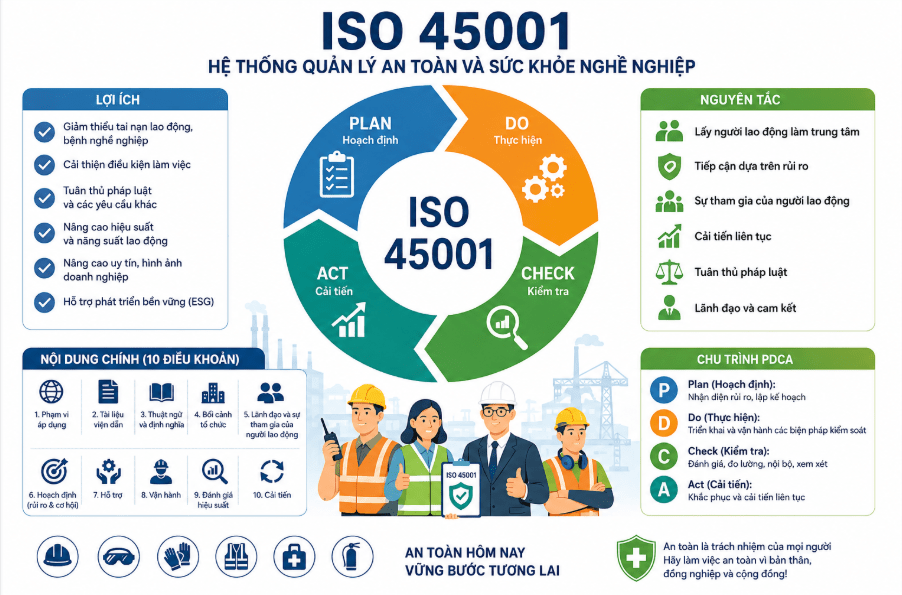
In today’s industrial and service sectors, workplace safety is no longer just about wearing helmets or gloves. It is a strategic management challenge to protect a business’s most valuable asset: People. ISO 45001 was born as the ultimate international standard, helping organizations eliminate hazards, minimize accidents, and build a sustainable safety culture.
This article provides a comprehensive overview of what ISO 45001 is, its key requirements, socio-economic benefits, and the roadmap for achieving this prestigious certification.
1. What is the ISO 45001 Standard?
ISO 45001:2018 is the world’s first international standard for Occupational Health and Safety (OH&S). Released in March 2018 to replace the old OHSAS 18001, it sets a framework to improve employee safety, reduce workplace risks, and create better, safer working conditions.
The breakthrough of ISO 45001 is its adoption of the High-Level Structure (HLS), allowing it to integrate seamlessly with other management systems like ISO 9001 (Quality) and ISO 14001 (Environment).
The Core Philosophy of ISO 45001:
- Proactive instead of Reactive: Focusing on identifying hazards before accidents occur.
- Worker Participation: Viewing employees as direct participants in the safety system.
- Continuous Improvement: Driven by the PDCA (Plan – Do – Check – Act) cycle.
2. Key Requirements and Clauses of ISO 45001
The ISO 45001 system consists of 10 clauses, with 7 critical requirements that businesses must implement:
2.1. Context of the Organization (Clause 4)
The business must determine internal and external issues that affect the OH&S system and understand the needs and expectations of workers and other interested parties.
2.2. Leadership and Worker Participation (Clause 5)
This is the “heart” of the system. Leadership must not only approve policies but also take direct responsibility for workplace safety. Additionally, the business must establish channels for workers to report safety concerns without fear of reprisal.
2.3. Planning (Clause 6)
Identify hazards and assess risks. From there, determine opportunities to improve OH&S performance and set specific safety objectives.
2.4. Support and Operation (Clauses 7 & 8)
- Provide resources, competency training, and raise awareness among employees.
- Implement operational controls, manage changes, and prepare for emergency responses.
2.5. Performance Evaluation and Improvement (Clauses 9 & 10)
Monitor and measure safety indicators, conduct internal audits, and perform corrective actions to ensure the system is constantly refined.
3. Key Benefits of ISO 45001 Certification
Implementing ISO 45001 brings practical and long-term value:
3.1. Minimizing Accidents and Occupational Illnesses
By managing risks systematically, businesses reduce unfortunate workplace accidents, protecting the lives and health of their workforce.
3.2. Saving on Insurance and Compensation Costs
Fewer accidents mean lower compensation payouts, medical bills, legal fees, and annual insurance premiums.
3.3. Increasing Productivity
A safe environment gives employees peace of mind, reducing downtime caused by incidents or sick leave, ensuring the production line operates stably.
3.4. Strengthening Reputation and Market Position
ISO 45001 certification is proof of corporate social responsibility, helping attract investors and making it easier to pass the strict evaluations of international clients.
4. The Process to Achieve ISO 45001 in Vietnam
Step 1: Gap Analysis
Assess the current state of workplace safety against the requirements of the standard to create an implementation roadmap.
Step 2: Training and Documentation
Provide awareness training for employees and develop a set of procedures, work instructions, and safety policies.
Step 3: Implementation
Apply the procedures to real-world operations. Conduct environmental monitoring and inspect machinery that requires strict safety requirements.
Step 4: Internal Audit and Management Review
Self-check to detect non-conformities and implement corrective measures before the official audit.
Step 5: Certification Audit
An independent certification body will conduct a two-stage audit (document review and on-site audit).
Step 6: Certification and Surveillance
The certificate is valid for 3 years. During this time, the certification body will conduct annual surveillance audits.
5. ISO 45001 vs. OHSAS 18001 (The Old Standard)
| Criteria | OHSAS 18001 (Old) | ISO 45001 (New) |
| Structure | Procedure-based | Process-based |
| Approach | Reactive to risks | Proactive management of risks & opportunities |
| Leadership Role | Delegated to a safety manager | Leadership is directly accountable |
| Worker Participation | Limited | Mandatory and extensive |
| Organizational Context | Not emphasized | Requires review of internal & external factors |
6. Frequently Asked Questions (FAQ)
6.1. Do service-based businesses need ISO 45001?
Yes. Although physical risks are lower than in manufacturing, risks related to electricity, office fires, business travel, and occupational health still exist.
6.2. Is ISO 45001 mandatory under Vietnamese law?
Currently, the law does not mandate every business to have this certificate. However, it helps businesses meet 100% of the requirements of the Law on Occupational Safety and Health in the most scientific way.
6.3. What are the costs of maintaining ISO 45001?
Beyond annual surveillance fees, the main costs lie in maintaining safety equipment, providing PPE (Personal Protective Equipment), and periodic training for staff.
7. Conclusion – ISO 45001 is the Foundation of Sustainable Development
Investing in ISO 45001 is never a waste. It is an investment in the future, where a business grows not just in profit figures but also in human values. A safe business is a resilient and trustworthy business.
Contact us for ISO 45001 Certification Consultancy
Let our team of experts accompany you in building an international-standard safe working environment. Contact us today for a survey and the most suitable roadmap!
Business Consultation & Support Contact:
Hotline: +84 933096426 – +84 868 591 260
Email:
Website:
Strategic Partners in Vietnam:
Contact Vietnam representative: Duc Luong Services
Hotline: +84 933096426 – +84 868 591 260
Email: ducluongservices@gmail.com
Website:
STC VN Co., Ltd.
Hotline: +84 933096426 – +84 868 591 260
Email: info@staunchlyservices.com.vn
Website: https://stauchlyservices.com.vn
Duc Luong Services | Your Trusted Partner. Effective Implementation.
 Duc Luong Services