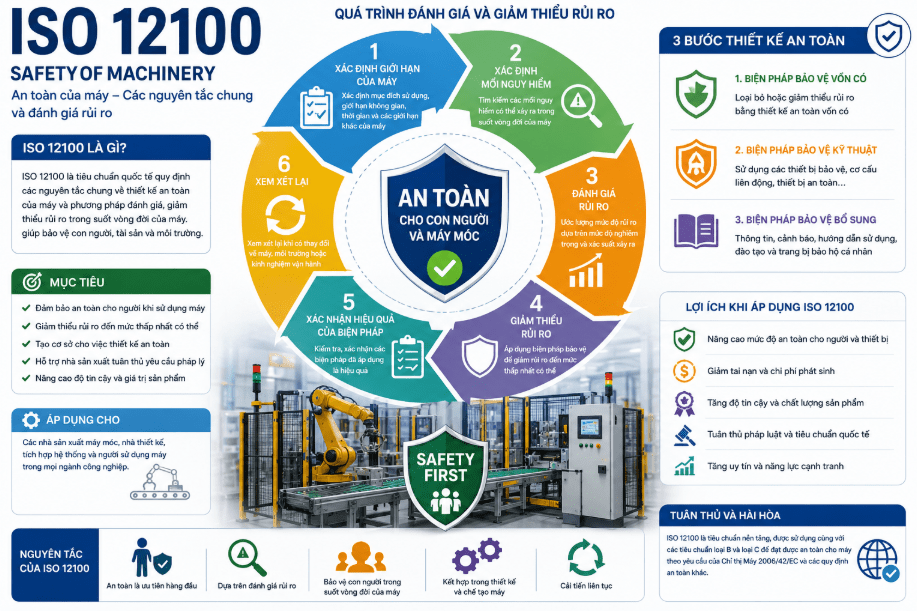
In the manufacturing industry, a high-quality machine is not just one that performs well; it must be safe by design. ISO 12100 serves as the “constitution” for engineers and manufacturers, providing general principles for risk assessment and risk reduction. Its goal is to create equipment that poses no danger to humans or the environment throughout its entire lifecycle.
This article will help you understand what ISO 12100 is, the 3-step risk reduction process, the strategic benefits, and how to apply this standard to achieve international safety certifications (such as the CE Mark).
1. What is the ISO 12100 Standard?
ISO 12100:2010 (Safety of machinery – General principles for design – Risk assessment and risk reduction) is the international standard that specifies basic terminology, methodology, and general principles for achieving safety in machinery design.
ISO 12100 is classified as a Type-A Standard—the most fundamental level. All other specific machinery safety standards (Type-B and Type-C) must be built upon the principles established in ISO 12100.
Core Philosophy of ISO 12100:
- Safety by Design: Preventing hazards at the drafting stage on the drawing board, rather than relying solely on external protective measures.
- Machinery Lifecycle: Considering risks from installation, operation, and maintenance to decommissioning and disposal.
2. Risk Assessment and Reduction Process
ISO 12100 establishes an iterative process consisting of two main parts: Risk Assessment and Risk Reduction.
2.1. Risk Assessment
This is a scientific analysis involving:
- Determining machinery limits: What is the machine’s intended use? Who are the operators? What environment does it operate in?
- Hazard identification: Listing physical hazards (crushing, cutting), electrical hazards, heat, noise, or radiation.
- Risk estimation and evaluation: Determining the severity of potential injury and the probability of occurrence to decide if the risk is acceptable.
2.2. Risk Reduction – The 3-Step Method
If a risk is deemed unacceptable, the designer must apply the following hierarchy of measures:
- Inherently safe design: Altering the machine’s structure to eliminate the hazard (e.g., replacing toxic chemicals, rounding sharp edges).
- Safeguarding and complementary protective measures: If the design cannot be changed, use physical barriers, safety sensors, or covers.
- Information for use: If residual risks remain, provide warning signs, signal lights, and detailed operator training manuals.
3. Benefits of ISO 12100 Compliance
Applying ISO 12100 brings sustainable value to both manufacturers and end-users:
3.1. Meeting International Legal Requirements
Compliance with ISO 12100 is a prerequisite for obtaining the CE Marking for exports to Europe or meeting OSHA regulations in the USA.
3.2. Reducing Legal Liability and Incident Costs
Safe machinery helps businesses avoid expensive lawsuits, workers’ compensation costs, and losses due to machine failure or forced shutdowns.
3.3. Optimizing Production Costs
Identifying risks during the design phase prevents the need for costly structural modifications after mass production has begun—which is significantly more expensive.
3.4. Enhancing Brand Reputation
A manufacturer certified in ISO 12100 demonstrates technical competence and responsibility toward customers, making products more acceptable to large global corporations.
4. Implementation Process for Businesses
Step 1: Form an Assessment Team
Include design engineers, safety experts, and actual operators to gain a multi-dimensional view of potential hazards.
Step 2: Technical Analysis and Hazard Identification
Use the checklists provided in the ISO 12100 annexes to ensure no hazard is missed—from mechanical and electrical to ergonomics.
Step 3: Implement Risk Reduction
Prioritize technical drawing improvements before considering barriers or warning labels.
Step 4: Documentation
Create a detailed risk assessment report. This is the most critical technical file to prove compliance to quality inspection authorities.
Step 5: Verification and Calibration
Once the prototype is built, conduct test runs to verify that safety measures function exactly as calculated.
5. ISO 12100 vs. Other Safety Standards
| Criteria | ISO 12100 | ISO 13849-1 | ISO 45001 |
| Object | Machinery (Design) | Safety Control Systems | Management System (People) |
| Focus | General Design Principles | Reliability of Circuits/Software | Safety Culture & Procedures |
| Standard Type | Type A (Fundamental) | Type B (Group Standard) | Management Standard |
| Application | Machine Manufacturers | Automation Engineers | Machine Operators/Owners |
6. Frequently Asked Questions (FAQ)
6.1. Does ISO 12100 replace specific machine standards (e.g., for lathes or presses)?
No. You use ISO 12100 for the general framework, then combine it with a Type-C standard (e.g., ISO 16090 for milling machines) for specific technical parameters.
6.2. Do businesses that only buy and use machines need ISO 12100?
Yes. Users should use ISO 12100 criteria to re-verify the safety of equipment before putting it into production or when retrofitting old machinery.
6.3. How important is the Risk Assessment documentation?
Extremely important. In the event of an accident, this is the primary legal evidence proving that the manufacturer fulfilled their responsibility in predicting and preventing risks.
7. Conclusion – Safety is the Highest Form of Quality
In the Industry 4.0 era, where machines are becoming smarter and more complex, the role of ISO 12100 is more vital than ever. It does not just protect people from physical harm; it provides the foundation for manufacturers to confidently enter the global supply chain.
The journey to master ISO 12100 is a journey of asserting technical excellence and a professional business mindset.
Contact us for ISO 12100 Machinery Risk Assessment Consultancy
We provide technical consultancy, risk assessment training, and support in preparing international-standard technical files. Contact us today to protect your team and elevate your products!
Business Consultation & Support Contact:
Hotline: +84 933096426 – +84 868 591 260
Email:
Website:
Strategic Partners in Vietnam:
Contact Vietnam representative: Duc Luong Services
Hotline: +84 933096426 – +84 868 591 260
Email: ducluongservices@gmail.com
Website:
STC VN Co., Ltd.
Hotline: +84 933096426 – +84 868 591 260
Email: info@staunchlyservices.com.vn
Website: https://stauchlyservices.com.vn
Duc Luong Services | Your Trusted Partner. Effective Implementation.
 Duc Luong Services