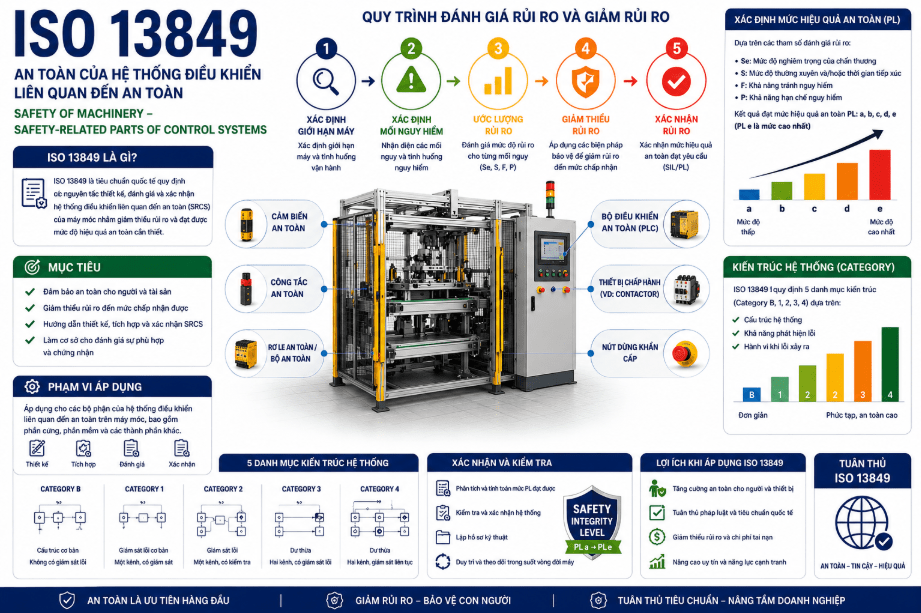
If ISO 12100 provides the conceptual framework for machinery safety, then ISO 13849 is the set of technical rules that turn that safety into reality through control systems. In an age dominated by robotics and automated production lines, ensuring that a sensor, a PLC, or an emergency stop button operates reliably is a matter of life and death. ISO 13849 provides the mathematical formulas and technical structures to measure the “reliability” of these safety functions.
This article will help you understand what ISO 13849 is, the concept of Performance Levels (PL), the determining factors, and the process for designing an international-standard safety control system.
1. What is the ISO 13849 Standard?
ISO 13849-1 (Safety of machinery – Safety-related parts of control systems) is an international standard providing safety requirements and guidance on the principles for the design and integration of safety-related parts of control systems (SRP/CS).
This standard applies to all types of energy used for control (electrical, hydraulic, pneumatic, and mechanical). The unique aspect of ISO 13849 is its combination of qualitative aspects (system structure) and quantitative aspects (probability of dangerous failures), allowing businesses to calculate the exact safety level of their equipment.
Key Concepts:
- Safety Function: A function of the machine whose failure can result in an immediate increase of the risk(s) (e.g., stopping the machine when a guard door is opened).
- Performance Level (PL): A discrete level used to specify the ability of safety-related parts of control systems to perform a safety function under foreseeable conditions.
2. Performance Levels (PL) and the 4 Deciding Factors
To determine if a control system is safe enough, ISO 13849 uses a scale from PL a (lowest) to PL e (highest). This level is determined by four technical parameters:
2.1. System Structure (Category)
There are 5 Categories (B, 1, 2, 3, 4). Higher categories require better redundancy and self-monitoring. For example, Category 4 requires that a single fault does not lead to the loss of the safety function and must be detected before the next demand.
2.2. Mean Time to Dangerous Failure (MTTFd)
This is a quantitative value indicating the reliability of components. Better components lead to a higher MTTFd (Low, Medium, High).
2.3. Diagnostic Coverage (DC)
This measures the effectiveness of self-monitoring within the system. If a component fails, does the system “know” enough to stop the machine immediately?
2.4. Common Cause Failure (CCF)
This assesses the system’s resistance to systematic failures (such as electrical noise or overheating) that could damage multiple redundant channels simultaneously.
3. Benefits of Applying ISO 13849 in Production
Compliance with ISO 13849 brings significant technological and economic value:
3.1. Ensuring Absolute Machinery Reliability
Instead of guesswork, businesses can prove with specific data that their emergency stop or light curtain systems have an extremely low probability of failure, ensuring absolute safety for operators.
3.2. Optimizing Component Costs
ISO 13849 helps designers choose components that are “just right” for the required risk level. You don’t need to purchase the most expensive components (PL e) for a position that only requires a medium safety level (PL c).
3.3. A “Passport” for Machine Manufacturers
To have machinery accepted in demanding markets like the EU, USA, or Japan, PL calculations according to ISO 13849 are a mandatory part of the technical file.
3.4. Minimizing Systematic Failure Risks
The standard’s rigorous process helps eliminate design errors in both software and hardware, resulting in stable machine operation and reduced downtime.
4. The 6-Step Design Process for Safety Control Systems
Step 1: Determine the Required Performance Level (PLr)
Based on the risk assessment (ISO 12100), identify the required PL for each safety function.
Step 2: Design the System Architecture
Select components (input, logic, output) and connection diagrams (Category) accordingly.
Step 3: Calculate Quantitative Parameters
Collect data from component manufacturers to calculate MTTFd, DC, and CCF.
Step 4: Determine the Achieved Performance Level (PL)
Use specialized software (like SISTEMA) or ISO 13849 lookup tables to calculate the actual PL of the design.
Step 5: Verification
Check if the achieved PL is greater than or equal to the required PL (PLr). If not, return to Step 2 to improve the design.
Step 6: Validation
Perform physical testing (such as fault injection) to ensure the system reacts exactly as designed.
5. ISO 13849 vs. IEC 62061
| Criteria | ISO 13849-1 | IEC 62061 |
| Safety Scale | Performance Level (PL a – e) | Safety Integrity Level (SIL 1 – 3) |
| Technologies | Electric, Mechanical, Pneumatic, Hydraulic | Primarily Electric, Electronic, Programmable |
| Complexity | Visual, easy for individual machines | More complex, designed for large lines |
| Approach | Structure-based (Categories) | Probability-based (Failure rates) |
6. Frequently Asked Questions (FAQ)
6.1. Do I need to be a math expert to calculate ISO 13849?
Not necessarily. There are several free software tools available (such as SISTEMA from IFA) that allow you to input component data and automatically calculate the PL for you.
6.2. Why did I use PL e-rated components, but my system only reached PL c?
Because the system’s PL depends on how you connect them (Category). If you use a PL e sensor but connect it in a single-channel structure (no redundancy), the overall safety level is pulled down significantly.
6.3. What is the difference between ISO 13849-1 and 13849-2?
Part 1 focuses on design principles and calculations. Part 2 focuses on Validation procedures to verify that the design actually works as intended in practice.
7. Conclusion – Safe Control is the Core of Sustainable Automation
In the Industry 4.0 revolution, the interaction between humans and machines is becoming closer (such as with collaborative robots/cobots). In this context, ISO 13849 is no longer a technical barrier but a foundation of trust.
Applying ISO 13849 helps businesses not only protect people but also elevate product value, turning safety technology into a sharp competitive advantage in the global market.
Contact us for ISO 13849 Design and Calculation Consultancy
We assist businesses in calculating Performance Levels, providing SISTEMA software training, and standardizing safety control systems according to international standards. Contact us today to optimize the safety of your production lines!
Business Consultation & Support Contact:
Hotline: +84 933096426 – +84 868 591 260
Email:
Website:
Strategic Partners in Vietnam:
Contact Vietnam representative: Duc Luong Services
Hotline: +84 933096426 – +84 868 591 260
Email: ducluongservices@gmail.com
Website:
STC VN Co., Ltd.
Hotline: +84 933096426 – +84 868 591 260
Email: info@staunchlyservices.com.vn
Website: https://stauchlyservices.com.vn
Duc Luong Services | Your Trusted Partner. Effective Implementation.
 Duc Luong Services