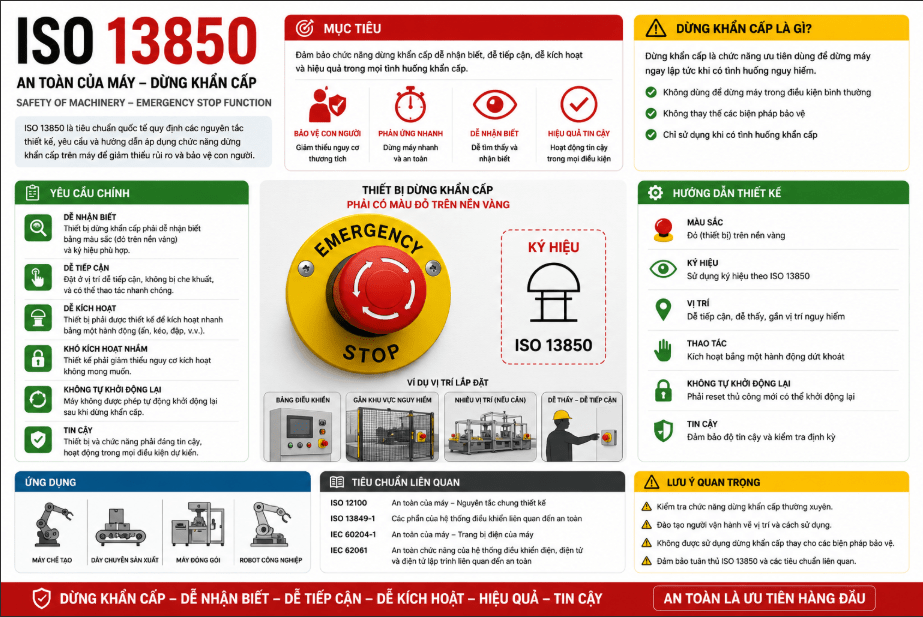
In machinery operation, when an unexpected dangerous situation arises, the difference between a minor incident and a catastrophic disaster often lies in a single button: the Emergency Stop. However, it is not as simple as just installing a red button. ISO 13850 establishes strict standards for design, color, and functional logic to ensure that the emergency stop function is always available and operates reliably in the most critical moments.
This article will help you understand what ISO 13850 is, the mandatory design principles, stop categories, and the roadmap for businesses to standardize their systems according to international requirements.
1. What is the ISO 13850 Standard?
ISO 13850:2015 (Safety of machinery – Emergency stop function – Principles for design) is an international standard that specifies design principles for the emergency stop function of machinery. This function is intended to avert arising hazards or reduce existing hazards to persons, machinery, or work in progress.
ISO 13850 is classified as a Type-B2 Standard—a group safety standard focused on a specific safety device.
Core Philosophies of ISO 13850:
- Highest Priority: The emergency stop function must be available at all times and override all other operating modes.
- Maintained State: Once activated, the system must maintain the stop command until the device is manually reset by a person.
- Not a Substitute for Guarding: Emergency stop is a complementary measure; it must never be used as a replacement for primary safeguarding measures (such as physical fences or light curtains).
2. Mandatory Design and Operational Requirements
ISO 13850 provides detailed specifications for the appearance and behavior of emergency stop devices to prevent confusion:
2.1. Color and Shape (Visual Identification)
- Actuator (Button): Must be RED and mushroom-headed to allow for easy activation by the palm of the hand, fist, or elbow.
- Background (Mounting): Must be YELLOW. The Red/Yellow combination is a mandatory requirement to ensure the emergency stop is identifiable from a distance.
- Wire/Cable Pulls (if used): Must be red and easily accessible at any point along its length.
2.2. Stop Categories
ISO 13850 references IEC 60204-1 to classify three ways of stopping:
- Stop Category 0: Immediate removal of power to the machine actuators (uncontrolled stop).
- Stop Category 1: A controlled stop where power is maintained to the actuators to achieve the stop, and then power is removed (ideal for high-inertia machines).
- Stop Category 2: A controlled stop where power is left available to the machine actuators (generally not used for emergency stops except in very specific applications).
2.3. Latching Mechanism (Self-Holding)
The emergency stop device must have a mechanical latching mechanism. This means that when the button is pressed, it must remain “stuck” in the stop position. To restart the machine, an operator must manually “reset” the button by twisting or pulling it.
3. Benefits of ISO 13850 Compliance
Standardizing the emergency stop system brings absolute peace of mind to a manufacturing facility:
3.1. Immediate Response in Panic Situations
During a panic, humans act on instinct. The Red/Yellow design and mushroom head of ISO 13850 allow anyone—even a new employee—to identify and activate the stop in less than a second.
3.2. Ensuring Global Compatibility
If your machinery is exported to Europe (CE Mark) or the USA (UL/OSHA), the lack of an ISO 13850-compliant emergency stop button will lead to immediate rejection at customs or during safety audits.
3.3. Eliminating Operational Errors
The regulation prohibiting other red buttons near the emergency stop helps prevent accidental shutdowns, thereby avoiding unnecessary downtime.
3.4. Protecting Equipment from Severe Damage
The emergency stop protects not just people but the machinery itself during severe mechanical failures (such as workpiece jams or tool breakages), minimizing repair costs.
4. Implementation and Testing Roadmap
Step 1: Placement Assessment
Based on ISO 12100, identify locations where an operator might encounter danger. Emergency stop buttons must be placed at every control station and other easily accessible locations.
Step 2: Selecting Certified Devices
Choose buttons certified for ISO 13850 compliance, ensuring they feature a “Positive Mode” mechanism (direct opening of the circuit by the pressing force).
Step 3: Integration into the Control System
Connect the emergency stop to a safety circuit that achieves the required Performance Level (PL) according to ISO 13849-1.
Step 4: Validation and Testing
Test the button in various operating modes to ensure the machine stops within the specified time and cannot restart automatically without a manual reset.
Step 5: Employee Training
Instruct employees on the location of the buttons and the specific procedures to follow after an emergency stop has been triggered.
5. Emergency Stop vs. Normal Stop
| Criteria | Normal Stop | Emergency Stop |
| Purpose | To end the production process | To prevent immediate danger |
| Color | Usually Black, White, or Grey | Mandatory Red on a Yellow background |
| Mechanism | Controlled by software/logic | Usually a hard-wired circuit break |
| State | Can be restarted immediately | Must be manually reset to restart |
| Location | Only at the main control panel | Anywhere a risk exists |
6. Frequently Asked Questions (FAQ)
6.1. Can I use the emergency stop to turn off the machine daily?
No. Frequent use can decrease the mechanical lifespan of the button and potentially damage electrical systems due to sudden power loss. Use the “Normal Stop” button for daily shutdowns.
6.2. How many emergency stop buttons can a machine have?
There is no limit. ISO 13850 requires enough buttons so that an operator can reach one instantly from any operating position.
6.3. Does an emergency stop button need an “EMERGENCY STOP” label?
ISO 13850 prefers the use of a graphical symbol (a circle with an arrow) to avoid language barriers, but text labels are acceptable as long as they do not obscure the required colors.
7. Conclusion – Small Button, Great Responsibility
ISO 13850 reminds us that in machinery safety, simplicity and consistency are key. A compliant emergency stop system is not just a technical requirement; it is a mark of respect for human life.
Investing in an ISO 13850-compliant system is building the strongest “last line of defense” for your business.
Contact us for Emergency Stop Installation and Inspection Services
We provide end-to-end solutions, from placement consultancy and device supply to stopping-time verification. Contact us today to ensure your machinery is always under control!
Business Consultation & Support Contact:
Hotline: +84 933096426 – +84 868 591 260
Email:
Website:
Strategic Partners in Vietnam:
Contact Vietnam representative: Duc Luong Services
Hotline: +84 933096426 – +84 868 591 260
Email: ducluongservices@gmail.com
Website:
STC VN Co., Ltd.
Hotline: +84 933096426 – +84 868 591 260
Email: info@staunchlyservices.com.vn
Website: https://stauchlyservices.com.vn
Duc Luong Services | Your Trusted Partner. Effective Implementation.

