BSCI – SÁNG KIẾN TUÂN THỦ XÃ HỘI TRONG KINH DOANH 

BSCI LÀ GÌ?

BSCI, viết tắt của Business Social Compliance Initiative (Sáng kiến tuân thủ xã hội trong kinh doanh) là một bộ tiêu chuẩn quốc tế được phát triển bởi Hiệp hội kinh doanh thương mại bền vững toàn cầu (Amfori) phát triển vào năm 2003 và hiện thuộc quyền sở hữu của Amfori. BSCI là tiêu chuẩn quốc tế, tự nguyện, cung cấp đầy đủ quy tắc ứng xử và hệ thống giám sát ở Châu Âu về trách nhiệm xã hội trong chuỗi cung ứng.

Bộ quy tắc ứng xử BSCI hướng dẫn các thành viên Amfori và đối tác kinh doanh của họ thực hiện hoạt động kinh doanh có trách nhiệm, đồng thời nhận diện, ngăn ngừa, giảm thiểu, giải trình và khắc phục những tác động bất lợi đến quyền con người cũng như môi trường trong chuỗi cung ứng của mình.

Phiên bản BSCI mới nhất là 2021 có hiệu lực từ ngày 01/01/2023. Các bên tham gia có trách nhiệm áp dụng Bộ quy tắc ứng xử này trong những hoạt động của mình và thực hiện đánh giá để xác minh sự tuân thủ.

Tiêu chuẩn BSCI được áp dụng cho tất cả các tổ chức, doanh nghiệp trong mọi ngành nghề, lĩnh vực, không phân biệt loại hình, địa điểm hay quy mô.
Tuy nhiên BSCI không phải là tiêu chuẩn để chứng nhận, BSCI cung cấp một phương pháp tiếp cận, phát triển từng bước, giúp các nhà sản xuất thực hiện những quy tắc ứng xử trong lao động.

MỤC TIÊU DÀI HẠN CỦA BSCI

BSCI không chỉ là một cam kết, mà còn thể hiện một tầm nhìn dài hạn với tham vọng biến đổi các doanh nghiệp trong việc cải thiện vấn đề xã hội và lao động, hướng tới một tương lai bền vững, công bằng, và tôn trọng nhân quyền. Những mục tiêu dài hạn mà BSCI theo đuổi gồm:

a. Khuyến khích điều kiện lao động được xã hội chấp nhận

BSCI khuyến khích tạo ra môi trường làm việc mà mọi người đều được đối xử công bằng, các quyền cơ bản của người lao động được tôn trọng, nhằm đảm bảo điều kiện lao động xã hội trở thành một tiêu chuẩn tự nhiên, không chỉ là một yêu cầu.

b. Hướng tới hoạt động thương mại cởi mở và bền vững

BSCI thúc đẩy việc thực hiện hoạt động thương mại không chỉ có lợi nhuận mà còn dựa trên trách nhiệm xã hội và môi trường, biến đổi cách doanh nghiệp quản lý nguồn tài nguyên, sản xuất và tiếp thị sản phẩm để đảm bảo tính bền vững và tương thích với môi trường.

c. Ủng hộ điều kiện làm việc công bằng và an toàn

BSCI chú trọng đến việc đảm bảo an toàn và công bằng trong điều kiện làm việc, đặc biệt tại những đất nước có nhà cung cấp của doanh nghiệp, tạo ra sự thay đổi đáng kể trong việc cải thiện điều kiện làm việc và đảm bảo an toàn cho tất cả công nhân.

d. Thể hiện cam kết của doanh nghiệp

Áp dụng BSCI là doanh nghiệp cam kết đảm bảo công bằng trong ngành sản xuất, cải thiện điều kiện làm việc và xây dựng một cộng đồng quốc tế tôn trọng quyền con người.

Như vậy mục tiêu dài hạn của BSCI không chỉ đặt ra thách thức doanh nghiệp mà còn giúp họ thúc đẩy sự phát triển và thay đổi nhận thức tích cực trong nền kinh tế Toàn cầu.

11 NGUYÊN TẮC CỦA BSCI

Bộ tiêu chuẩn BSCI tập trung vào 11 nguyên tắc sau:

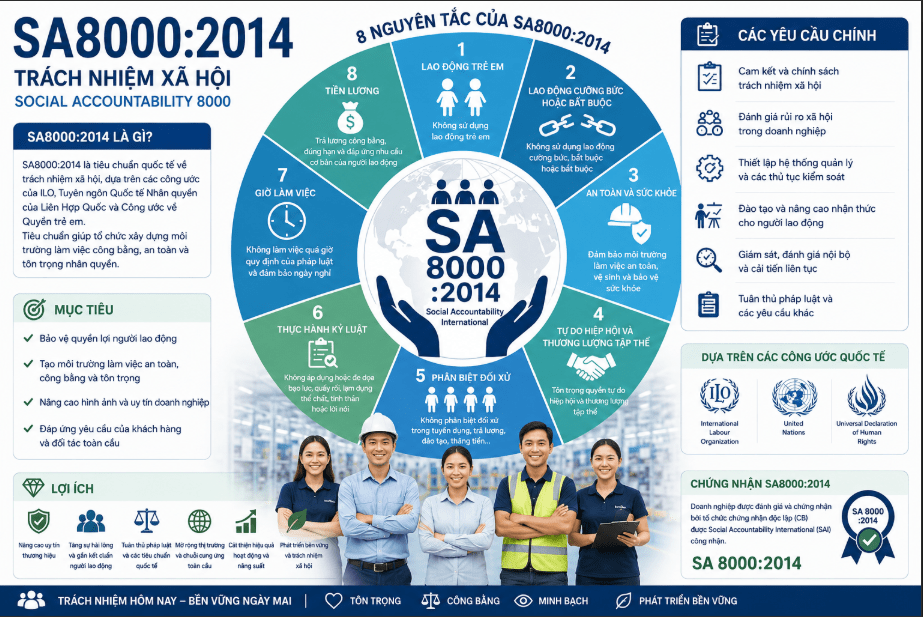
  1. Quyền tự do lập hiệp hội và quyền đàm phán tập thể

Người lao động có quyền thành lập, gia nhập vào tổ chức công đoàn do họ lựa chọn, đồng thời có quyền thương lượng tập thể với chủ doanh nghiệp, lãnh đạo cấp trên.

Doanh nghiệp phải tôn trọng quyền này, đưa ra thông báo chính thức và đảm bảo rằng việc đó sẽ không dẫn đến bất kỳ hậu quả tiêu cực nào đối với người lao động và không có bất kỳ sự trả thù nào từ doanh nghiệp.

  1. Không phân biệt đối xử

Doanh nghiệp cần đảm bảo không có sự phân biệt đối xử, khai trừ hay ưu tiên đặc biệt nào trong việc tuyển dụng, trả lương, bổ nhiệm, thăng chức, chấm dứt hợp đồng hoặc nghỉ hưu dựa trên giới tính, tuổi tác, tôn giáo, chủng tộc, đẳng cấp, nền tảng xã hội, khuyết tật, nguồn gốc dân tộc và quốc gia, quốc tịch, tư cách thành viên trong các tổ chức của người lao động (bao gồm công đoàn, đảng phái chính trị) hoặc ý kiến, khuynh hướng tình dục, trách nhiệm gia đình, tình trạng hôn nhân hoặc bất kỳ điều kiện nào khác có thể dẫn đến phân biệt đối xử.

  1. Trả lương công bằng

Doanh nghiệp phải tuân thủ mức lương tối thiểu do chính phủ quy định hoặc các tiêu chuẩn ngành nghề đã được phê duyệt trên cơ sở thương lượng tập thể, để công nhân có cuộc sống đầy đủ, lo được cho bản thân và gia đình.

Tiền lương phải được trả đúng hạn, đầy đủ. Mức lương chi trả theo đúng kỹ năng, trình độ của người lao động, xứng đáng với những gì họ bỏ ra. Việc khấu trừ lương chỉ được thực hiện trong mức độ cho phép của pháp luật hoặc được ấn định bởi các thỏa thuận tập thể.

  1. Giờ công làm việc xứng đáng

Không bắt buộc người lao động làm việc nhiều hơn 48 giờ/ tuần. Những trường hợp ngoại lệ do vượt quá số giờ làm phải có sự đồng ý từ phía người lao động và họ phải được trả công xứng đáng, với mức phí cao hơn thông thường. Giờ làm thêm cần đảm bảo không ảnh hưởng tới sức khỏe người lao động.

Có giờ nghỉ giải lao cho một ngày làm việc. Người lao động có quyền được nghỉ ít nhất 1 ngày trong 7 ngày làm việc, trừ trường hợp ngoại lệ do thương lượng tập thể quy định.

  1. Sức khỏe và an toàn lao động

Doanh nghiệp tôn trọng quyền được hưởng điều kiện sống và làm việc lành mạnh của người lao động. Những cá nhân dễ bị tổn thương như lao động trẻ, phụ nữ mới sinh và những người khuyết tật sẽ nhận được sự bảo vệ đặc biệt.

Doanh nghiệp cần tuân thủ các định về an toàn và sức khỏe nghề nghiệp. Đảm bảo môi trường làm việc an toàn, lành mạnh, có hệ thống phát hiện, đánh giá và phòng chống các mối nguy có thể ảnh hưởng đến an toàn của người lao động.

Cung cấp trang thiết bị bảo hộ miễn phí cho người lao động, đảm bảo hỗ trợ y tế và cung cấp các phương tiện liên quan khi có sự cố xảy ra.

  1. Không sử dụng lao động trẻ em

Không tuyển dụng trực tiếp hoặc gián tiếp người lao động dưới 15 tuổi. Doanh nghiệp phải xác minh độ tuổi lao động trong quá trình tuyển dụng.

Khi đưa trẻ em ra khỏi nơi làm việc, cần có biện pháp đảm bảo chúng sẽ không tham gia vào những công việc nguy hiểm hơn như: mại dâm, buôn bán ma túy…

  1. Bảo vệ đặc biệt đối với lao động trẻ tuổi

Đảm bảo rằng những người trẻ tuổi không làm việc vào ban đêm và họ được bảo vệ trước điều kiện làm việc có hại cho sức khỏe, an toàn, đạo đức và sự phát triển của họ.

Thời gian làm việc của lao động trẻ tuổi cần đảm bảo không ảnh hưởng tới thời gian đi học, định hướng nghề nghiệp. Có cơ chế khiếu nại và chương trình đào tạo phù hợp dành cho lao động trẻ em.

  1. Không cung cấp việc làm tạm thời

Doanh nghiệp phải ký hợp đồng với người lao động theo quy định của pháp luật, không cung cấp việc làm tạm thời. Cung cấp đầy đủ thông tin về quyền, trách nhiệm và điều kiện làm việc cho người lao động trước khi họ bắt đầu làm việc, bao gồm: thời gian làm việc, trợ cấp, thù lao, ngày nghỉ phép, chế độ bảo hiểm…

  1. Không sử dụng lao động lệ thuộc

Doanh nghiệp không được tham gia vào bất kỳ hình thức nô dịch, ép buộc, ngoại giao, nhận ủy thác, buôn bán hoặc lao động không tự nguyện. Thận trọng khi thu hút, tuyển dụng trực tiếp hoặc gián tiếp lao động nhập cư. Đảm bảo người lao động không bị đối xử vô nhân đạo, hạ nhục, đánh đập, đe dọa… Tất cả các hình thức kỷ luật cần được thông báo bằng văn bản và giải thích rõ ràng cho người lao động.

  1. Bảo vệ môi trường

Doanh nghiệp cần tránh làm suy thoái môi trường, hạn chế tối đa ảnh hưởng xấu của quá trình kinh doanh, sản xuất tới môi trường. Để làm được điều này, doanh nghiệp cần có đánh giá các mối nguy và có biện pháp phòng ngừa, xử lý hiệu quả khi có tác động xấu xảy ra.

  1. Hành vi kinh doanh có đạo đức

Không tham gia vào bất kỳ hành vi tham nhũng, tống tiền hoặc tham ô nào, cũng không thực hiện bất kỳ hình thức hối lộ nào – bao gồm nhưng không giới hạn – hứa hẹn, đề nghị, cho hoặc nhận bất kỳ khoản tiền không phù hợp hoặc động cơ khác.

Việc thu thập, sử dụng và xử lý thông tin cá nhân khác phải tuân thủ luật riêng tư và bảo mật thông tin của người lao động.

PHƯƠNG THỨC TIẾP CẬN BSCI

Để áp dụng tiêu chuẩn Bi S Si Ai, các thành viên của Hiệp hội kinh doanh thương mại bền vững toàn cầu (Amfori) cần thực hiện các vấn đề như sau:

  • Chấp hành bộ quy tắc: Doanh nghiệp đảm bảo các quyền lợi của người lao động theo luật pháp và tiêu chuẩn BSCI
  • Sự tham gia & bảo vệ người lao động: Duy trì việc thông báo về quyền lợi và trách nhiệm cho người lao động
  • Quản lý chuỗi cung ứng: Sử dụng quy tắc BSCI để gây ảnh hưởng đến các đối tác kinh doanh khác
  • Cơ chế khiếu nại: Cung cấp một hệ thống để thu thập khiếu nại và đề xuất từ nhân viên

Trong quá trình phát triển và hội nhập xu thế kinh doanh bền vững với thế giới, các doanh nghiệp tại Việt Nam ngày càng chú trọng thực hiện trách nhiệm xã hội trong chuỗi cung ứng của mình. Để giúp cho doanh nghiệp của bạn tìm hiểu và áp dụng tiêu chuẩn BSCI, Công ty Tiêu chuẩn hóa quốc tế ISC Việt nam sẵn sàng cung cấp dịch vụ tư vấn trọn gói do các chuyên gia nhiều năm kinh nghiệm thực hiện. Nếu có nhu cầu áp dụng BSCI, hãy liên hệ ngay với ISC chúng tôi bạn nhé.

CONTACT FOR SERVICE SUPPORT:

Contact Vietnam representative: Duc Luong Services

Hotline: +84 933096426 – +84 868 591 260

Email: info.vietnam@iscglobal.asia – van.pham@iscglobal.asia – ducluongservices@gmail.com

REGISTER FOR SERVICE HERE: APPLICATION FORM!

ISO 14000 – BỘ TIÊU CHUẨN VỀ QUẢN LÝ MÔI TRƯỜNG

BỘ TIÊU CHUẨN ISO 14000 LÀ GÌ?

Bộ tiêu chuẩn ISO 14000 là tập hợp một nhóm tiêu chuẩn dành cho hoạt động quản lý môi trường của các doanh nghiệp, tổ chức. Bộ tiêu chuẩn ISO 14000 được Tổ chức Tiêu chuẩn hóa Quốc tế ISO xây dựng và chính thức ban hành vào năm 1996. Từ đó tiêu chuẩn ISO 14000 đã trải qua nhiều lần cải tiến, cập nhập để phù hợp với bối cảnh về môi trường; cho tới nay bộ tiêu chuẩn ISO 14000 đã được phát triển gồm những tiêu chuẩn chính như sau: 

 ISO 14001: Hệ thống quản lý môi trường ISO 14001 - Các yêu cầu và hướng dẫn sử dụng. Đây là tiêu chuẩn phổ biến nhất và cũng là cốt lõi của bộ tiêu chuẩn ISO 14000. Tiêu chuẩn này đóng vai trò như bộ khung chuẩn để doanh nghiệp có thể xây dựng và áp dụng hệ thống quản lý môi trường đạt hiệu quả tối ưu. Phiên bản mới nhất đang áp dụng và có hiệu lực là ISO 14001:2015.

 ISO 14004: Hệ thống quản lý môi trường – Hướng dẫn chung các nguyên tắc, hệ thống và các kỹ thuật hỗ trợ.

ISO 14010: Hướng dẫn đánh giá môi trường – Các nguyên tắc chung.

 ISO 14011: Hướng dẫn đánh giá môi trường – Thủ tục đánh giá – Đánh giá hệ thống quản lý môi trường.

 ISO 14012: Hướng dẫn đánh giá môi trường – Tiêu chuẩn năng lực đối với chuyên gia đánh giá môi trường. 

 ISO 14020: Nhãn môi trường & Công bố môi trường.

 ISO 14031: Quản lý môi trường – Đánh giá kết quả thực hiện về môi trường

 ISO 14040: Quản lý môi trường – Đánh giá vòng đời của sản phẩm – Nguyên tắc và khuôn khổ.

 ISO 14050: Từ vựng về quản lý môi trường.

 ISO 14064:  Quy trình kiểm kê khí nhà kính và giảm thiểu khí thải

 ISO guide 64: Hướng dẫn đề cập tới khía cạnh môi trường trong tiêu chuẩn sản phẩm. 

ĐỐI TƯỢNG ÁP DỤNG BỘ TIÊU CHUẨN ISO 14000

Doanh nghiệp nào cũng có thể áp dụng theo ISO 14000. Bộ tiêu chuẩn ISO 14000 không giới hạn cho việc doanh nghiệp nào được hay không được áp dụng nó trong công tác quản lý môi trường. Từ các đơn vị sản xuất tới các tổ chức kinh doanh, cung ứng dịch vụ hay thực hiện xuất nhập khẩu hay các tổ chức phi lợi nhuận vân vân… tất cả đều có thể áp dụng các tiêu chuẩn trong ISO 14000. Đặc biệt các doanh nghiệp có mong muốn xây dựng hoặc cải thiện hiệu quả cho hệ thống quản lý môi trường của mình rất cần áp dụng bộ tiêu chuẩn này. 

MỤC TIÊU CỦA BỘ TIÊU CHUẨN QUẢN LÝ MÔI TRƯỜNG ISO 14000

Các tiêu chuẩn trong hệ thống môi trường ISO 14000 được xây dựng đòi hỏi doanh nghiệp cần phải đáp ứng được các mục tiêu cốt lõi sau đây:

‒ Xác định những yêu cầu về mặt pháp luật liên quan đến môi trường trong hoạt động sản xuất, kinh doanh của doanh nghiệp. 

‒ Xác định những lĩnh vực và hoạt động liên quan tới môi trường mà doanh nghiệp có khả năng kiểm soát. 

‒ Xác định rủi ro và cơ hội xuất hiện trong các hoạt động môi trường của doanh nghiệp. 

‒ Thiết lập được chính sách môi trường, các mục tiêu cùng phương pháp để đạt được chúng.

‒ Thiết lập hoạt động giám sát, theo dõi và đánh giá hiệu quả của hệ thống quản lý môi trường.

Để đạt được các mục tiêu này doanh nghiệp, tổ chức cần phải triển khai một số hoạt động bao gồm: 

‒ Thể hiện cam kết của ban lãnh đạo về việc triển khai và áp dụng ISO 14000. 

‒ Ban hành những quy định về môi trường, yêu cầu đội ngũ nhân viên và các bên liên quan cần phải tuân thủ. 

‒ Thiết lập các biện pháp quản lý, kiểm soát quá trình sản xuất kinh doanh có liên quan tới môi trường trong doanh nghiệp. 

‒ Xây dựng các kế hoạch, những chương trình riêng biệt để mọi khía cạnh môi trường liên quan tới hoạt động của doanh nghiệp được kiểm soát. 

‒ Gắn kết công tác quản lý môi trường vào với công việc hàng ngày và văn hóa của doanh nghiệp. 

‒ Xây dựng các cuộc đánh giá để phát hiện những sự không phù hợp, từ đó có biện pháp khắc phục, phòng ngừa kịp thời và phù hợp. 

‒ Tuyên truyền và đào tạo cho các bên liên quan về ISO 14000. 

LỢI ÍCH CỦA VIỆC ÁP DỤNG BỘ TIÊU CHUẨN MÔI TRƯỜNG ISO 14000

ISO 14000 sẽ đem đến cho doanh nghiệp, tổ chức áp dụng nó một số lợi ích nổi bật như sau: 

‒ Giảm thiểu các ảnh hưởng tiêu cực tới môi trường thông qua việc hạn chế tối đa chất thải công nghiệp và phân bố nguồn tài nguyên hợp lý hơn. 

‒ Giúp tiết kiệm chi phí nguyên liệu đầu vào, chi phí hạch toán môi trường, từ đó góp phần tối ưu chi phí hoạt động chung cho doanh nghiệp. 

‒ ISO 14000 được sử dụng như một công cụ tiếp thị hiệu quả để gia tăng uy tín cùng hình ảnh tốt đẹp của doanh nghiệp.

‒ Hạn chế các rủi ro và áp lực gặp phải từ quy chế hay chế tài về môi trường trong quá trình cung ứng sản phẩm, dịch vụ ra thị trường. 

‒ Đóng góp vào các hoạt động vì môi trường, hướng tới một tương lai phát triển bền vững không chỉ cho bản thân doanh nghiệp mà còn cho toàn xã hội.

‒ Tăng cường hiệu quả hoạt động quản lý môi trường của doanh nghiệp.

‒ Có thể tương thích và kết hợp với các hệ thống quản lý ISO khác, ví dụ như ISO 9001, để nâng cao hiệu quả hoạt động chung của doanh nghiệp. 

‒ Đặc biệt khi doanh nghiệp có được chứng nhận ISO 14001 sẽ là tấm giấy thông hành giúp doanh nghiệp tiếp cận thị trường quốc tế nhanh chóng thông qua việc đáp ứng các tiêu chuẩn khắt khe về môi trường. 

CÁC YÊU CẦU CỦA HỆ THỐNG QUẢN LÝ MÔI TRƯỜNG THEO ISO 14000

Việc xây dựng một hệ thống quản lý môi trường theo tiêu chuẩn ISO 14000 sao cho phù hợp và hiệu quả đòi hỏi doanh nghiệp cần phải đáp ứng được những yêu cầu cơ bản như sau: 

  • Đảm bảo có sự tham gia và cam kết từ lãnh đạo cao nhất của doanh nghiệp từ khi triển hai cho đến quá trình xem xét định kỳ.
  • Có một chính sách môi trường phù hợp với định hướng và cam kết của doanh nghiệp.
  • Các mục tiêu, kế hoạch môi trường cần phải tương thích và giải quyết được các chính sách môi trường đã đặt ra, đồng thời, có thể thực hiện và đo lường được. 
  • Phải xây dựng và áp dụng hệ thống quản lý môi trường dựa trên bối cảnh thực tế của tổ chức và điều kiện môi trường nơi tổ chức hoạt động. 
  • Phân bố nguồn lực hợp lý, xác định rõ vai trò, quyền hạn cùng trách nhiệm của những người tham gia hệ thống quản lý môi trường.
  • Thực hiện đào tạo cho đội ngũ cán bộ nhân viên về hệ thống quản lý môi trường theo ISO 14000.
  •  Đảm bảo nguồn nhân lực tham gia và thực hiện quản lý môi trường phải thực sự có đầy đủ năng lực và phẩm chất phù hợp. 
  •  Các thông tin trong hệ thống quản lý môi trường phải được truyền đạt rõ ràng, đúng đối tượng và kịp thời trong nội bộ doanh nghiệp cũng như bên ngoài với các bên quan tâm. 
  • Thiết lập hệ thống tài liệu, hồ sơ về hệ thống quản lý môi trường đầy đủ, chính xác, đảm bảo tính sẵn có. Chúng phải được kiểm soát, lưu trữ và cập nhập thường xuyên.
  • Thiết lập các chương trình đánh giá, giám sát cùng các biện pháp, hành động khắc phục, phòng ngừa các mối nguy gây ảnh hưởng tới môi trường. 
  • Cải tiến liên tục để phù hợp với bối cảnh kinh tế – xã hội – môi trường thực tế. 

CHỨNG NHẬN HỆ THỐNG QUẢN LÝ MÔI TRƯỜNG THEO ISO 14000 

Bộ ISO 14000 bao gồm một nhóm các tiêu chuẩn: ISO 14001, 14004, 14005 … Trong những tiêu chuẩn này chỉ có ISO 14001 có thể được chứng nhận. Như vậy nhắc đến chứng nhận về môi trường theo ISO 14000 cũng chính là việc doanh nghiệp được chứng nhận hay cấp chứng chỉ đạt tiêu chuẩn ISO 14001, cụ thể là phiên bản ISO 14001:2015 hiện đang có hiệu lực.

Tổ chức chứng nhận sẽ đánh giá doanh nghiệp để cấp chứng chỉ ISO 14001:2015 theo quy trình gồm các bước như sau:

Bước 1: Đăng ký chứng nhận ISO 14001:2015

Doanh nghiệp khai báo các thông tin theo yêu cầu của Tổ chức chứng nhận ISO 14001 để đăng ký chứng nhận hệ thống quản lý môi trường.

Bước 2: Kí kết hợp đồng chứng nhận

Doanh nghiệp ký kết hợp đồng xác nhận việc đồng ý đánh giá chứng nhận ISO 14001 với tổ chức chứng nhận và chuẩn bị cho đánh giá chính thức hệ thống quản lý môi trường.

Bước 3: Đánh giá giai đoạn 1

Tổ chức chứng nhận ISO 14001 đánh giá sơ bộ giai đoạn 1 về Hệ thống quản lý môi trường của doanh nghiệp (thông qua hồ sơ, tài liệu nhận được).

Bước 4: Đánh giá giai đoạn 2

Tổ chức chứng nhận đánh giá thực tế giai đoạn 2, trong đó tiến hành các cuộc phỏng vấn và xem xét tại hiện trường của doanh nghiệp.

Bước 5: Thẩm định hồ sơ, tài liệu, quy trình ISO 14001

Tổ chức chứng nhận thẩm định hồ sơ, tài liệu, quy trình liên quan tới việc xây dựng Hệ thống quản lý môi trường theo ISO 14001 của doanh nghiệp.

Bước 6: Hành động khắc phục

Doanh nghiệp phải tiến hành hành động khắc phục trong thời gian quy định và báo cáo lại cho Tổ chức chứng nhận ISO để sửa chữa những điểm chưa tuân thủ (nếu có).

Bước 7: Cấp chứng chỉ ISO 14001:2015

Tổ chức chứng nhận cấp chứng chỉ ISO 14001 cho doanh nghiệp sau khi kiểm tra chắc chắn rằng doanh nghiệp đã hoàn thành các khắc phục theo yêu cầu. Chứng chỉ này có hiệu lực trong vòng 03 (ba) năm.

Bước 8: Đánh giá giám sát định kỳ

Doanh nghiệp sẽ trải qua 2 cuộc đánh giá giám sát định kỳ trong 3 năm (12 tháng/lần) để duy trì hiệu lực của chứng nhận ISO 14001.

Bước 9: Tái chứng nhận ISO 14001:2015

Doanh nghiệp tái đánh giá chứng nhận ISO 14001 sau 3 năm khi chứng chỉ hết hiệu lực, quy trình tái đánh giá chứng nhận lặp lại tương tự như các bước trên.

Để giúp cho các doanh nghiệp tìm hiểu, áp dụng bộ tiêu chuẩn ISO 14000 và đi tới đánh giá chứng nhận hệ thống quản lý môi trường đạt tiêu chuẩn ISO 14001:2015 được nhanh chóng, thuận lợi, Công ty tiêu chuẩn quốc tế ISC Việt Nam chúng tôi có cung cấp dịch vụ chứng nhận ISO 14001 tuân theo những quy định hiện hành mới nhất năm 2025 cho tất cả các ngành nghề, lĩnh vực. Hãy liên hệ ngay với ISC Việt Nam khi có nhu cầu bạn nhé.
Liên hệ/Contact: Hotline: 0933096426 – Ms. Vân Phạm

CONTACT FOR SERVICE SUPPORT:

Contact Vietnam representative: Duc Luong Services

Hotline: +84 933096426 – +84 868 591 260

Email: info.vietnam@iscglobal.asia – van.pham@iscglobal.asia – ducluongservices@gmail.com

REGISTER FOR SERVICE HERE: APPLICATION FORM!

BCI Membership Registration Service – Better Cotton

Sustainable integration solutions for cotton businesses 

About BCI – Better Cotton Initiative 

The Better Cotton Initiative (BCI) is a global non-profit organization with the goal of promoting sustainable cotton production in the world. Established in 2005, BCI aims to improve environmental, economic, and social conditions for cotton production, benefiting not only farmers but also the entire supply chain and end consumers. Currently, BCI is the largest sustainable cotton program in the world, present in more than 20 countries and cooperates with hundreds of partners from businesses, NGOs to retail companies and brands. 

Benefits of becoming a BCI member 

  • Affirming social and environmental responsibility: Joining BCI demonstrates the company’s commitment to sustainable development, reducing negative impacts on the environment and community. 
  • Access to a global network: BCI members can connect with prestigious international businesses and organizations, expand cooperation and business development. 
  • Promoting sustainable production standards: Applying BCI standards helps businesses improve product quality, optimize production processes, save resources and increase economic efficiency. 
  • Enhancing brand position: Brands, factories, and farms participating in BCI are highly appreciated by consumers and partners for their responsibility and transparency in the supply chain. 
  • Trained and updated knowledge: Members will be updated with the latest information on farming techniques, market trends, and participate in intensive training programs from BCI. 

Types of BCI Membership 

BCI offers a variety of membership types to suit each role in the cotton supply chain, including: 

  • Producer Member: Individuals, cooperatives, and businesses that directly grow and harvest cotton. 
  • Supply Chain Member: Fiber factories, textiles, distributors, trading companies involved in the cotton supply chain. 
  • Retailer & Brand Member: Brands and retailers use BCI cotton in their products. 
  • Associate Member: Non-governmental organizations, associations, research units, service providers related to the cotton sector. 

BCI Membership Registration Process 

To join BCI, organizations/businesses need to take the following basic steps: 

1. Find out the conditions and requirements 

Businesses should carefully learn about the standards, code of conduct, obligations and benefits of BCI members. This information can be found on BCI’s official website or through consulting partners. 

2. Prepare the registration dossier 

  • Fill out the application form (according to the form provided by BCI). 
  • Provide legal documents related to the business (Business license, certification of production facilities, cooperatives, etc.) 
  • Present actual ongoing activities related to cotton, supply chain or brand (if applicable). 

3. Submit documents and pay fees 

  • Application documents are submitted online via BCI’s portal or sent via official email. 
  • Pay an annual subscription fee and membership fee (fees vary by membership type, size, and country). BCI will announce the corresponding fee in detail. 

4. Evaluation and review 

  • BCI will review the application, conduct an interview/supplement information if necessary. 
  • Businesses may be invited to participate in a presentation on the monitoring process, supply chain audits, and traceability standards. 

5. Receive confirmation and become an official member 

After the application is approved, businesses will receive confirmation of membership, account access to the BCI system, the right to use the BCI logo and participate in events, seminars, and training programs. 

BCI Membership Registration Support Service 

In order for BCI membership to go smoothly, many consultants or authorized agents provide support services including: 

  • Consulting on selecting the type of member in accordance with the development goals of the enterprise. 
  • Detailed instructions on preparing documents, completing forms and necessary documents. 
  • Support for translation and notarization of documents (if necessary). 
  • In-house training on standards, production processes and sustainable cotton management according to BCI. 
  • Help businesses connect with BCI’s global network of members. 
  • Supervise, monitor and update changes in regulations and standards of the BCI organization. 

Notes when registering as a BCI member 

  • Ensure honesty and transparency: Enterprises must commit to providing complete and accurate information about production and business activities, and the origin of cotton. 
  • Proactively update standards: BCI’s regulations and criteria may change from time to time, businesses should regularly update and adjust accordingly when joining the network. 
  • Compliance with inspection and supervision: BCI requires periodic inspections of cotton production and traceability processes to ensure sustainability commitments. 
  • Maximize member benefits: Actively participate in training programs, events, and connect partners to develop business networks. 

Becoming a member of BCI – Better Cotton not only helps businesses improve their reputation and brand position, but also opens up many opportunities for sustainable development cooperation with international partners. Although the membership registration process requires careful preparation, with the support of consultants, businesses will easily integrate into the BCI network, joining hands to build an environmentally and socially friendly cotton industry.

CONTACT FOR SERVICE SUPPORT:

Contact Vietnam representative: Duc Luong Services

Hotline: +84 933096426 – +84 868 591 260

Email: info.vietnam@iscglobal.asia – van.pham@iscglobal.asia – ducluongservices@gmail.com

REGISTER FOR SERVICE HERE: APPLICATION FORM!

About the Singapore Green Labelling Scheme (SGLS) 

Singapore’s Green Symbol for Sustainable Environment 

Overview of the Singapore Green Labelling Scheme (SGLS) 

The Singapore Green Labelling Scheme (SGLS) is one of the oldest and most prestigious eco-labelling schemes in Asia. Founded in 1992 by the Singapore Environment Council (SEC), SGLS aims to promote the production and consumption of environmentally friendly products and support sustainable development through authentication,  promote products that meet strict environmental criteria. 

History of establishment and development 

The SGLS program was born in the context of increasing awareness of environmental protection around the world. As Singapore thrives economically and industrialised, issues related to pollution, resource consumption, and waste become increasingly urgent. Since 1992, SGLS has pioneered the application of environmental criteria and standards for goods and services, creating a foundation for the green consumption movement in Singapore and influencing countries in the region. 

Over the past three decades, the program has been continuously updated to meet international standards, while expanding the scope of application to many different types of products and fields such as building materials, household appliances, chemicals, electronic equipment, food, services, etc. 

Meaning and Objectives of SGLS 

  • Certifying and recognizing truly environmentally friendly products based on objective scientific criteria 
  • Encourage manufacturers and businesses to improve processes, technologies and raw materials to meet ecological standards 
  • Supporting consumers to recognize and choose green products easily, contributing to minimizing negative impacts on the environment 
  • Promoting Singapore to become a pioneer in sustainable development and environmental protection in the Asia-Pacific region 

Identification characteristics of SGLS 

SGLS’s logo is a green leaf with the words “Singapore Green Label”. Certified products will be allowed to print this label on packaging, promotional materials or tangible assets, making it easy for consumers to identify. 

SGLS is not only an environmental certification, but also a commitment to product quality, safety for public health, and transparency in information. 

Product evaluation criteria 

The SGLS program builds a specific system of criteria for each product group, based on the following main aspects: 

  • Resource saving: using recycled and renewable materials, minimizing the exploitation of irreversible resources 
  • Emission reduction: control and limit the generation of waste, toxic emissions and pollution 
  • Energy: energy-saving products during production and use 
  • Durability and recyclability: long-life design, easy to reuse or recycle at the end of life 
  • Health safety: does not contain toxic chemicals, does not pose a danger to users and the living environment 
  • Compliance with international and domestic environmental regulations 

Each type of product will have its own set of criteria, reflecting the specifics of the industry and the level of impact on the environment. 

SGLS Registration and Certification Process 

The SGLS certification process includes the following main steps: 

  • Registration: Businesses file filings, technical documents, product samples with the SEC 
  • Preliminary assessment: SEC conducts a review of the dossier, checks for completeness and validity 
  • Field inspection (if necessary): Assessment team to the production facility, process analysis, sample collection, laboratory testing 
  • Detailed evaluation: Comparison of environmental indicators with SGLS criteria for each product group 
  • Certification: After passing all the criteria, the product is granted SGLS certification within a certain period of time (usually 3 years) 
  • Periodic Monitoring: Surprise re-checks and evaluations during the use of certification to ensure businesses maintain standards 

Benefits of SGLS Certification 

SGLS certification brings many practical values to both businesses and consumers: 

  • Increase brand value: Products are identified as environmentally friendly, improve business reputation 
  • Green market access: Meeting the trend of green consumption, promoting exports to fastidious markets 
  • Reduced production costs: Thanks to process optimization, raw material and energy savings 
  • Encouraging innovation: Motivation for technological improvement, applying sustainable solutions 
  • Protecting the environment and public health: Reducing emissions, limiting toxic chemicals, contributing to building a sustainable society 

SGLS in the international context and development trends 

SGLS is an official member of the Global Ecolabelling Network (GEN), an organization that links prestigious eco-labeling programs around the world such as EU Ecolabel, Blue Angel (Germany), Nordic Swan (Northern Europe)… This helps SGLS ensure international standard compatibility, creating a bridge for Singaporean products to access the global market. 

In the trend of globalization and climate change, ecological standards are increasingly tightened, and consumers are increasingly interested in the environmental impact of products. SGLS constantly updates, improves criteria, expands applicable fields such as construction, transportation, electronics, food, tourism services, etc. 

Challenges and opportunities in the application of SGLS 

In addition to the obvious benefits, the application of SGLS still faces a number of challenges such as initial investment costs, limited public and business awareness of green consumption, and the process of technological innovation requires time and resources. However, in the long term, this is an inevitable trend for businesses to increase competitiveness, expand markets and contribute to the country’s sustainable development goals. 

The Singapore Green Labelling Scheme (SGLS) is not only an environmental certification but also a symbol of trust, quality and social responsibility. SGLS inspires businesses, consumers and communities towards a green, civilized and sustainable future. In the context of fiercely competitive global economy, SGLS has become a strategic advantage for pioneering businesses in innovation and sustainable development in Singapore and the region.

CONTACT FOR SERVICE SUPPORT:

Contact Vietnam representative: Duc Luong Services

Hotline: +84 933096426 – +84 868 591 260

Email: info.vietnam@iscglobal.asia – van.pham@iscglobal.asia – ducluongservices@gmail.com

REGISTER FOR SERVICE HERE: APPLICATION FORM!

About GDPR and Certification Consulting Services

Protect your personal data and your journey to international standards

What is GDPR?

The General Data Protection Regulation (GDPR) is a comprehensive set of legal rules of the European Union (EU) on the protection of personal data of European citizens. The GDPR officially came into effect on May 25, 2018, replacing the 1995 Data Protection Directive. The main purpose of the GDPR is to give individuals control over their personal data, while simplifying the legal environment for organizations/businesses operating inside and outside the EU when handling user data.

The GDPR not only applies to organizations and businesses based in the EU, but also extends its scope globally, to include any organization that processes the personal data of EU citizens, regardless of where the organization is located. This makes the GDPR a global standard for data security and privacy.

GDPR Fundamentals

  • Transparency and fairness: Personal data must be handled in a transparent, legal, and fair manner to the data subject.
  • Specific Purposes: Data is collected only for explicit, lawful purposes and is not subsequently processed for unrelated purposes.
  • Data Limit: Collect only the data that is most necessary for the intended purpose.
  • Accurate: Personal data must be updated, modified, or deleted when it is no longer accurate.
  • Limited storage: Data is stored only for as long as is necessary for the purpose of processing.
  • Security: Data must be adequately protected against the risks of unauthorized access, disclosure, loss, or destruction.
  • Demonstrate compliance: Organizations must demonstrate compliance with GDPR guidelines through documentation, policies, and processes.

Individual rights under the GDPR

The GDPR imposes many important rights for individuals, including:

  • Right to information: Know how personal data is processed, by whom and for what purposes.
  • Access: Request access to personal data that the organization is storing about it.
  • Right to Modify: Request correction of inaccurate or incomplete data.
  • Right to erasure: Request erasure of personal data in certain circumstances (the right to be forgotten).
  • Right to restrict processing: Restrict the processing of data in specified situations.
  • Right to data portability: Receive personal data in a structured format and transfer it to another entity.
  • Right to object: Object to the processing of personal data for direct marketing purposes or for the legitimate interests of the organization.
  • Right not to be automatically processed: Not to be affected by decisions that rely solely on automated data processing, including profiling.

GDPR compliance challenges for businesses

GDPR compliance is a complex process that requires organizations to revisit the entire process of collecting, storing, processing, and protecting personal data. Common challenges include:

  • Evaluation and mapping of personal data in internal systems.
  • Develop or update data privacy policies in accordance with the GDPR.
  • Train employees to be aware of data security and privacy.
  • Establish a system to record the consent of the data subject (consent management).
  • Ensure that the rights of individuals are fully enforced through the process of querying, modifying, and deleting data.
  • Prepare troubleshooting measures in the event of a data leak or breach.
  • Meet the requirements for proof of compliance in inspections or inspections from authorities.
  • Failure to comply with the GDPR can result in very high fines – up to 20 million euros or 4% of total global revenue per year, whichever is greater.

GDPR Certification Consulting Services

To meet the increasingly stringent requirements of the GDPR, many organizations/businesses choose to cooperate with professional consultants to achieve compliance certification. GDPR certification consulting services play an important role in:

  • Assess the current state of compliance and identify weaknesses in the personal data protection system.
  • Build a GDPR compliance roadmap that is tailored to the specifics of each business.
  • Assist in the development of policies, processes, and documentation demonstrating compliance.
  • Consulting on technical solutions such as data encryption, access management, network security, end-to-end protection.
  • Train employees on the awareness and procedures for handling personal data.
  • Support the preparation and participation in independent audits and assessments to obtain certification from reputable organizations.
  • Propose solutions to manage risks and respond to personal data leaks.

Benefits of using GDPR certification consulting services

  • Ensure legal compliance, avoid large fines and legal risks.
  • Increase the reputation and trust of customers and partners with a commitment to protect personal data.
  • Supporting the optimization of data management processes, improving operational efficiency.
  • Minimize the risk of data loss, leakage as well as financial and reputational damage.
  • Equip your staff with knowledge and skills in security, privacy and risk management.

GDPR Certification Consulting Process

Here are the basic steps that are often applied by consultants to accompany businesses:

  • Status Survey: Assess the current system, determine the scope of data processing and potential weaknesses and risks.
  • Compliance planning: Develop a specific roadmap to meet GDPR requirements, from changes in technology and processes to personnel training.
  • Implement the solution: Coordinate with businesses to update and complete the data protection system and related internal processes.
  • Internal training & communication: Organize courses and seminars on GDPR awareness for all employees.
  • Internal inspection and evaluation: Conduct physical inspections, simulate violation situations to improve response capacity.
  • Certification preparation consulting: Supporting businesses to prepare documents, processes, and interact with independent certification organizations.
  • Continuous monitoring: Propose measures to maintain, update the system, handle legal changes as well as new risks.

GDPR is an important and global standard for protecting personal data and privacy. Compliance not only helps businesses avoid legal risks but also strengthens their reputation and improves their competitiveness in the international arena. GDPR certification consulting services are an effective companion solution, helping businesses step by step build a strong, effective and sustainable data protection system, meeting the increasing requirements of laws and customers in today’s digital era.

CONTACT FOR SERVICE SUPPORT:

Contact Vietnam representative: Duc Luong Services

Hotline: +84 933096426 – +84 868 591 260

Email: info.vietnam@iscglobal.asia – van.pham@iscglobal.asia – ducluongservices@gmail.com

REGISTER FOR SERVICE HERE: APPLICATION FORM!

BSCI TRAINING, CONSULTANCY AND CERTIFICATION SERVICES

Comprehensive solutions for businesses towards sustainable development

About BSCI

BSCI (Business Social Compliance Initiative) is an initiative organized by the European Foreign Trade Association (FTA), to enhance social responsibility in the global supply chain. BSCI helps businesses build management systems in accordance with standards of labor, environment, human rights and business ethics, and creates favorable conditions for businesses to access international markets, especially the European market.

The importance of BSCI in business operations

As the world becomes more and more integrated, standards of social responsibility in business have become a mandatory requirement for businesses participating in international supply chains. Compliance with BSCI standards not only helps businesses improve their image and reputation, but also expands opportunities for cooperation with major partners, ensures sustainable development, as well as increases competitiveness in the global market.

  • Prevent legal risks: The application of BSCI standards helps businesses reduce the risk of violating laws related to labor, the environment and human rights.
  • Building trust with partners: BSCI certification is a testament to the company’s commitment to social responsibility, thereby creating a reputation with customers and international partners.
  • Increase brand value: BSCI compliant enterprises are often highly appreciated and have an advantage when competing in large bidding packages with foreign partners.
  • Promoting sustainable development: Compliance with labor and environmental standards helps businesses develop sustainably and stably.

BSCI Training Services

BSCI training is an important first step to help businesses understand the requirements, criteria and process of applying the BSCI system in production and business activities.

BSCI training content

  • About BSCI: History of BSCI, goals, core values of BSCI.
  • BSCI Standards and Principles: Learn 11 basic principles of labor rights, working conditions, environmental protection, and anti-corruption,…
  • Social responsibility management system: How to build, operate and maintain a management system in accordance with BSCI requirements.
  • Guidelines for self-assessment and preparation for BSCI audit: Methods of self-review, risk identification and overcoming weaknesses in the enterprise.
  • Handling practical situations: Analyzing and practicing solving common situations in the process of implementing BSCI.
  • Update the latest regulations and standards: Ensure that businesses always comply with BSCI requirements from time to time.

Participants in the training

  • Corporate Leadership
  • Production management personnel, quality management
  • Corporate Social Responsibility (CSR)
  • Human Resources, Environment, Occupational Safety Department

BSCI Consulting Services

BSCI Consulting helps businesses build a specific roadmap to meet BSCI’s requirements, from surveying the current situation, identifying strengths and weaknesses to building a complete management system, ready for independent audits and audits from outside.

Steps to BSCI Consultation

  • Survey and assessment of the current situation: Consultants will directly come to the business to survey, collect information, and compare with BSCI standards to identify problems that need improvement.
  • Building a social responsibility management system: Planning, developing internal processes and policies in accordance with BSCI requirements.
  • Training and implementation guidance: Organize internal training sessions and training for personnel to understand and properly implement the process.
  • Supporting the completion of documents and records: Developing and standardizing necessary forms, documents and reports for auditing.
  • Internal trial assessment: Organize a trial inspection to identify deficiencies and provide timely remedial measures.
  • Support in the BSCI audit process: Accompany businesses in the audit process, answer questions, handle arising issues.

Benefits of BSCI Consulting Services

  • Supported by a team of experienced experts in the field of corporate social responsibility.
  • Save time and costs in the process of building and deploying the system.
  • Raise awareness and social responsibility management capacity for human resources.
  • Ensure that the management system always meets the latest requirements and is ready for audit.

BSCI Certification Services

After the business has completed the management system in accordance with BSCI, the next step is to participate in the audit and receive BSCI certification carried out by independent audit organizations.

BSCI Certification Process

  • Audit registration: Enterprises select qualified audit organizations and register for BSCI audits.
  • Preparation of documents and dossiers: Complete documents related to policies, processes, reports, personnel records, environmental records,…
  • Conduct an audit at the enterprise: The audit team will come to conduct a field survey, interview, review documents, and observe working conditions.
  • Remediation of non-conformities (if any): If detecting non-compliance points, enterprises must develop a remedial plan and report the results.
  • BSCI certification: After fully meeting the requirements, businesses will be granted BSCI certification with international validity.

Notes during the certification process

  • BSCI certification is not a lifetime certificate but needs to be maintained and re-evaluated periodically (usually every 1-2 years).
  • Businesses need to constantly improve the system and update new regulations to ensure long-term compliance.
  • Reputable international auditing organizations are often recognized by foreign partners, so they should be prioritized for selection.

Overall Benefits of Applying and Achieving BSCI Certification

  • Improve reputation with international customers, especially European and American markets.
  • Meet the increasingly stringent requirements of international partners and retailers on social responsibility.
  • Increase competitiveness, expand opportunities for cooperation and export of goods.
  • Contributing to building a fair, safe and friendly working environment for employees.
  • Promote the sustainable development of businesses and communities.

BSCI training, consulting and certification services are a comprehensive solution for businesses that are aiming for sustainable development and international integration. Compliance and obtaining BSCI certification is not only a mandatory requirement of many markets but also brings long-term benefits in terms of reputation, brand value, human resource development and positive contribution to society. Businesses should actively research, deploy and select reputable training and consulting units to achieve optimal efficiency in the process of building and operating the BSCI system.

CONTACT FOR SERVICE SUPPORT:

Contact Vietnam representative: Duc Luong Services

Hotline: +84 933096426 – +84 868 591 260

Email: info.vietnam@iscglobal.asia – van.pham@iscglobal.asia – ducluongservices@gmail.com

REGISTER FOR SERVICE HERE: APPLICATION FORM!

ABOUT BSCI STANDARDS 

Social Responsibility Standards in Global Supply Chains 

BSCI (Business Social Compliance Initiative) is a prominent international standard in the field of corporate social responsibility (CSR) and supply chain control. Initiated by the German Foreign Trade Association (FTA) in 2003, BSCI aims to improve working conditions in global supply chains through a system of continuous evaluation, monitoring and improvement based on a common code of conduct.

What is BSCI?

BSCI stands for Business Social Compliance Initiative, which means Business Social Compliance Initiative. It is a system designed to help businesses, especially retailers, brands, and manufacturers, ensure that the production of their goods complies with ethical and social standards. This standard focuses on monitoring, evaluating, and assisting suppliers in complying with regulations on labor rights, working conditions, health and safety, and environmental protection.

History of establishment and development

BSCI was born in 2003 out of an urgent need to improve transparency and ethics in global supply chains, especially in developing countries, where labor rights violations, unsafe working conditions, child labor, and labor exploitation are widespread. Developed by the German Foreign Trade Association, BSCI is now part of Amfori – an international non-profit organization specializing in sustainable trade.

BSCI Objectives

  • Improve working conditions for workers throughout the supply chain.
  • Promote compliance with international labour standards, such as the ILO Declaration of Fundamental Principles and Rights at Work and the UN Declaration of Human Rights.
  • Create a healthy competitive environment and improve the social responsibility of businesses.
  • Supporting businesses to build a sustainable, transparent and responsible supply chain.

BSCI Fundamentals

BSCI develops a code of conduct based on international standards, which emphasizes 13 basic principles:

  • Freedom of association and the right to collective bargaining
  • Prohibition of discrimination
  • Salary standards (ensuring minimum wage, full and punctual salary payment)
  • Reasonable working hours
  • Occupational safety and health
  • Prohibition of child labor
  • Prohibition of forced labor
  • Environmental protection
  • Business ethics
  • Liability
  • Management system (process setting, training, supervision)
  • Zero-tolerance policy against corruption
  • Protection of personal data and privacy

BSCI Audit and Monitoring Process

To achieve BSCI certification, a factory or business must undergo the following rigorous assessment steps:

  • Registration: Businesses register with Amfori BSCI and receive guidance on the process.
  • Internal training and preparation: Officers and employees in the enterprise are trained on the standards and meaning of BSCI.
  • Third-Party Audit (Audit): Amfori BSCI appoints independent auditing organizations to conduct audits at factories or manufacturing facilities. The audit focuses on examining labor practices, working conditions, legal documents, interviewing employees, checking salary records, working hours, occupational safety and health,…
  • Report the results and classification: After the evaluation, the factory will receive the results according to the following levels: A (Excellent), B (Good), C (Acceptable), D (Needs improvement), E (Unsatisfactory).
  • Corrective action plan: If there is a score that is not satisfactory, the enterprise needs to take remedial measures and be monitored.
  • Periodic re-evaluation: To maintain certification, businesses must be re-evaluated according to the prescribed cycle (usually every 1-2 years).

Benefits of Adopting BSCI

The application of BSCI brings many great benefits to both businesses and employees:

  • Improve business reputation: BSCI certification is convincing evidence of social responsibility, helping businesses create a competitive advantage in the international market.
  • Expanding export markets: Many retailers and big brands in the world require suppliers to be BSCI certified to cooperate.
  • Improving working conditions: Employees are better protected in terms of rights, health and safety,…
  • Reduced legal and social risks: Businesses that comply with BSCI will reduce the risk of labor disputes, litigation, or boycotts.
  • Sustainable development: Effective supply chain management, ensuring environmental and social sustainability.

BSCI and related standards

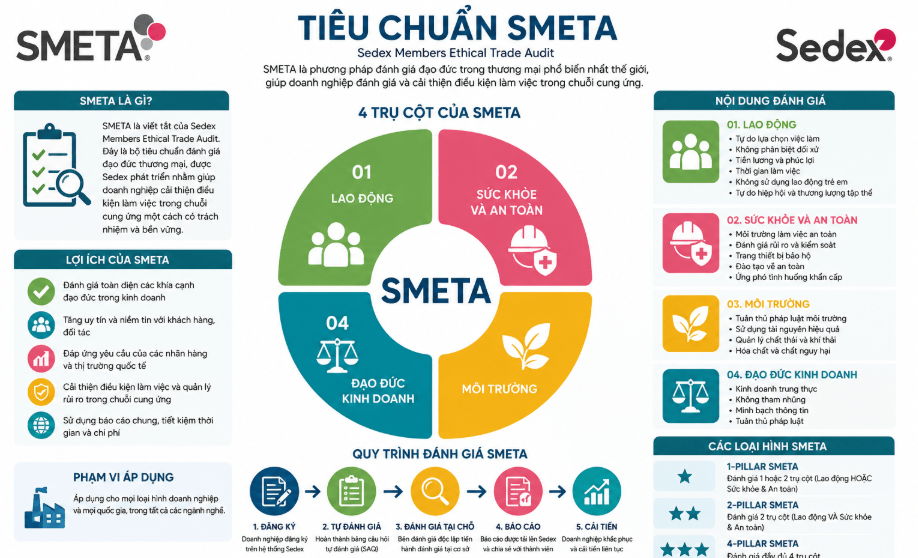
BSCI has many similarities with other social responsibility assessment systems such as SA8000, WRAP, SMETA, ETI,… However, BSCI has a specific code of conduct, which focuses on partnerships and continuous improvement, and creates a network of support, training, and information sharing among members.

Subjects of application of BSCI

BSCI standards mainly apply to manufacturing and processing enterprises in many fields such as textiles, footwear, furniture, food, handicrafts,… especially businesses exporting to the European and American markets or cooperating with international brands.

Challenges in implementing BSCI

Although it brings many benefits, the implementation of BSCI also faces many difficulties:

  • Initial investment costs for training, improvement of facilities and management systems,…
  • Changing organizational culture requires commitment from leaders to employees.
  • Meet strict criteria on laws, documents and processes,…
  • Complex supply chain control with multiple small, dispersed suppliers.

BSCI standards are an effective tool to help businesses build a professional image, build trust with international customers and ensure sustainable development. Compliance with BSCI principles not only benefits businesses but also contributes to improving the quality of life and rights of employees, contributing to the global trend of developing a just and humane society.

CONTACT FOR SERVICE SUPPORT:

Contact Vietnam representative: Duc Luong Services

Hotline: +84 933096426 – +84 868 591 260

Email: info.vietnam@iscglobal.asia – van.pham@iscglobal.asia – ducluongservices@gmail.com

REGISTER FOR SERVICE HERE: APPLICATION FORM!

GIỚI THIỆU VỀ CHỨNG NHẬN CE (CE MARKING)

Tầm quan trọng và quy trình chứng nhận CE cho sản phẩm tại thị trường châu Âu 

Chứng nhận CE là gì? 

Chứng nhận CE, hay còn gọi là CE Marking, là một biểu tượng được gắn trên các sản phẩm nhằm thể hiện rằng sản phẩm đó đáp ứng đầy đủ các yêu cầu của Liên minh châu Âu (EU) về an toàn, sức khỏe và bảo vệ môi trường. CE là viết tắt của cụm từ tiếng Pháp “Conformité Européenne”, nghĩa là “Phù hợp châu Âu”. Dấu CE không phải là một dấu chất lượng hoặc nhãn hiệu xuất xứ sản phẩm, mà là minh chứng cho việc sản phẩm đã tuân thủ các quy định pháp luật của EU và có thể tự do lưu thông trên thị trường các nước thuộc Khu vực Kinh tế châu Âu (EEA). 

Lịch sử phát triển của chứng nhận CE 

Dấu CE xuất hiện lần đầu tiên vào năm 1985 cùng với việc thành lập thị trường chung châu Âu. Ý tưởng đặt ra là tạo ra một hệ tiêu chuẩn chung cho toàn bộ các quốc gia thành viên nhằm loại bỏ rào cản thương mại, đồng thời đảm bảo mức độ an toàn tối thiểu cho những sản phẩm lưu hành trong khu vực. Qua hơn ba thập kỷ, hệ thống quy chuẩn và các chỉ thị liên quan đến CE không ngừng được cập nhật, mở rộng cho nhiều nhóm sản phẩm như thiết bị điện, đồ chơi, máy móc công nghiệp, thiết bị y tế, thiết bị đo lường, vật liệu xây dựng, và nhiều nhóm sản phẩm khác. 

Ý nghĩa và vai trò của chứng nhận CE 

Chứng nhận CE mang lại nhiều ý nghĩa và lợi ích to lớn: 

  • Minh chứng tuân thủ pháp luật: Sản phẩm có dấu CE được xác nhận đã tuân thủ các chỉ thị và quy định bắt buộc của EU liên quan đến an toàn, sức khỏe và bảo vệ môi trường. 
  • Được lưu hành tự do tại EEA: Khi đã có chứng nhận CE, sản phẩm có thể tự do lưu thông trong toàn bộ thị trường EEA mà không bị kiểm tra bổ sung về các yêu cầu kỹ thuật. 
  • Tăng niềm tin của khách hàng: Người tiêu dùng châu Âu thường ưu tiên lựa chọn sản phẩm có dấu CE vì tin tưởng vào mức độ an toàn và chất lượng tối thiểu được đảm bảo. 
  • Hỗ trợ doanh nghiệp mở rộng thị trường: Chứng nhận CE là điều kiện cần thiết để doanh nghiệp ngoài EU đưa sản phẩm vào thị trường châu Âu, tạo đà phát triển xuất khẩu và hội nhập toàn cầu. 
  • Giảm rủi ro pháp lý: Việc tuân thủ quy định CE giúp doanh nghiệp giảm thiểu nguy cơ bị phạt, thu hồi sản phẩm hoặc đối mặt với các rắc rối pháp lý tại châu Âu. 

Những sản phẩm bắt buộc phải có chứng nhận CE 

Không phải tất cả các sản phẩm đều yêu cầu phải gắn dấu CE. Tuy nhiên, với các sản phẩm thuộc nhóm nằm trong danh mục do EU quy định, việc chứng nhận CE là bắt buộc. Một số nhóm sản phẩm phổ biến bao gồm: 

  • Thiết bị điện và điện tử 
  • Máy móc công nghiệp 
  • Thiết bị y tế 
  • Đồ chơi trẻ em 
  • Thiết bị đo lường 
  • Vật liệu xây dựng 
  • Thiết bị bảo vệ cá nhân (PPE) 
  • Nồi hơi nước 
  • Thiết bị áp lực 

Ngoài ra, còn nhiều nhóm sản phẩm khác phải tuân thủ các quy định tương ứng. 

Quy trình chứng nhận CE 

Quá trình đạt được và sử dụng dấu CE gồm nhiều bước, tùy thuộc vào từng sản phẩm và quy định liên quan: 

  • Bước 1: Xác định chỉ thị và tiêu chuẩn áp dụng 
  • Doanh nghiệp cần xác định sản phẩm mình thuộc phạm vi điều chỉnh của chỉ thị nào (ví dụ: Chỉ thị Máy móc 2006/42/EC, Chỉ thị Thiết bị điện thấp áp 2014/35/EU, Chỉ thị Thiết bị y tế 2017/745/EU, v.v.). 
  • Bước 2: Đánh giá sự phù hợp 
  • Nhà sản xuất phải đánh giá sản phẩm dựa theo các phương pháp quy định, có thể là tự đánh giá hoặc thông qua bên thứ ba (tổ chức chứng nhận được chỉ định – Notified Body) nếu sản phẩm thuộc nhóm rủi ro cao. 
  • Bước 3: Chuẩn bị hồ sơ kỹ thuật 
  • Hồ sơ này phải đầy đủ các tài liệu minh chứng sản phẩm đáp ứng yêu cầu (bản vẽ kỹ thuật, bảng thông số, kết quả thử nghiệm, báo cáo kiểm định, hướng dẫn sử dụng, quy trình sản xuất…) 
  • Bước 4: Tuyên bố sự phù hợp (Declaration of Conformity) 
  • Nhà sản xuất hoặc đại diện được ủy quyền lập bản tuyên bố sản phẩm phù hợp với các chỉ thị, tiêu chuẩn liên quan và cam kết chịu trách nhiệm pháp lý về sản phẩm. 
  • Bước 5: Gắn dấu CE lên sản phẩm 
  • Sau khi hoàn tất các bước trên, sản phẩm được phép gắn dấu CE trực tiếp trên thân sản phẩm, bao bì hoặc tài liệu kèm theo sản phẩm. 

Lưu ý: Đối với một số nhóm sản phẩm, việc đánh giá sự phù hợp phải có sự tham gia của tổ chức chứng nhận độc lập được EU công nhận. 

Trách nhiệm pháp lý liên quan đến chứng nhận CE 

  • Nhà sản xuất là người chịu trách nhiệm cuối cùng về việc sản phẩm đáp ứng đầy đủ yêu cầu của các chỉ thị liên quan, dù sản phẩm được sản xuất ở bất kỳ đâu. 
  • Người nhập khẩu và nhà phân phối cũng phải đảm bảo rằng chỉ những sản phẩm đáp ứng đầy đủ quy định mới được đưa ra thị trường châu Âu. 
  • Trong trường hợp sản phẩm bị phát hiện không phù hợp, các cơ quan chức năng EU có quyền yêu cầu thu hồi, tiêu hủy sản phẩm và xử phạt nghiêm khắc. 

Nhận diện dấu CE đúng chuẩn 

Dấu CE hợp lệ có thiết kế cụ thể, với hai chữ cái “C” và “E” theo phong cách đặc biệt, không bị chỉnh sửa hoặc thay đổi tỉ lệ. Ngoài ra, dấu CE phải được gắn rõ ràng, dễ đọc và không thể xóa được trên sản phẩm, bao bì hoặc tài liệu đi kèm. Một số trường hợp, dấu CE được kèm thêm mã số của tổ chức chứng nhận nếu sản phẩm yêu cầu sự giám sát của bên thứ ba. 

Những lưu ý khi xin chứng nhận CE 

  • Chứng nhận CE không thay thế các chứng chỉ chất lượng quốc tế khác như ISO, UL, GS, v.v. mà chỉ tập trung vào sự phù hợp với các quy chuẩn của EU. 
  • Không phải tổ chức hay trung tâm nào cũng có quyền cấp dấu CE. Đối với sản phẩm cần bên thứ ba đánh giá, phải là các tổ chức được EU công nhận (Notified Body). 
  • Việc làm giả hoặc sử dụng dấu CE không hợp lệ có thể dẫn đến các hậu quả pháp lý nghiêm trọng và ảnh hưởng lớn đến uy tín doanh nghiệp. 
  • Hồ sơ kỹ thuật và tài liệu liên quan phải được lưu trữ trong suốt thời gian sản phẩm lưu hành trên thị trường và phải xuất trình khi có yêu cầu kiểm tra. 

Chứng nhận CE (CE Marking) không chỉ là yêu cầu pháp lý bắt buộc để sản phẩm được lưu hành tự do tại châu Âu mà còn là “giấy thông hành” giúp doanh nghiệp khẳng định chất lượng, uy tín và mở rộng cơ hội phát triển trên thị trường quốc tế. Việc hiểu rõ và thực hiện đúng quy trình chứng nhận CE là điều kiện tiên quyết để doanh nghiệp vững bước trong quá trình hội nhập, đảm bảo lợi ích cho cả nhà sản xuất, nhà nhập khẩu và người tiêu dùng. 

LIÊN HỆ HỖ TRỢ DỊCH VỤ: 

ISC Global 

International Standards Training & Certification Partner 

Contact Vietnam representative: Hoa Dang Duc Luong Co., Ltd. 

Hotline: +84 933096426 – +84 868 591 260 

Email: info@iscglobal.asiavan.pham@iscglobal.asiavan.pham@iscvietnam.netducluongservices@gmail.com 

INTRODUCTION TO CE CERTIFICATION (CE MARKING) 

Importance and Certification Process for CE Marking in the European Market 

What is CE Certification? 

CE Certification, or CE Marking, is a symbol affixed to products to indicate that the product complies with the safety, health, and environmental protection requirements of the European Union (EU). CE stands for “Conformité Européenne”, meaning “European Conformity.” The CE mark is not a quality label or indication of origin, but a declaration that the product meets EU legal requirements and is eligible for free circulation within the European Economic Area (EEA). 

History of CE Marking 

The CE marking was first introduced in 1985 with the establishment of the EU Single Market. The goal was to create a unified set of standards for all member countries to eliminate trade barriers and ensure a minimum safety level for products sold in the region. Over more than three decades, the system of directives and standards has expanded to cover various product groups, including electrical equipment, toys, industrial machinery, medical devices, measuring instruments, construction materials, and more. 

Significance and Benefits of CE Certification 

CE certification provides multiple advantages: 

  • Legal compliance: It confirms that the product meets all mandatory EU directives on safety, health, and environmental protection. 
  • Market access within the EEA: Products with CE marking can be freely traded across all EEA member countries without additional technical inspections. 
  • Consumer trust: European consumers tend to prefer products with CE marking due to their assurance of basic safety and compliance. 
  • Export & market expansion: CE is a key requirement for non-EU manufacturers wishing to export to Europe, opening doors to new international markets. 
  • Reduced legal risks: Proper CE compliance helps companies avoid fines, product recalls, or legal action within the EU. 

Products Requiring CE Marking 

Not all products require CE marking. However, for those falling under specific EU directives, CE marking is mandatory. Common product categories include: 

  • Electrical and electronic equipment 
  • Industrial machinery 
  • Medical devices 
  • Toys 
  • Measuring instruments 
  • Construction products 
  • Personal Protective Equipment (PPE) 
  • Steam boilers 
  • Pressure equipment 

(Other categories may also require CE compliance depending on the applicable directive.) 

The CE Certification Process 

The CE marking process varies depending on the product type and the applicable legislation, but generally includes the following steps: 

  1. Identify relevant directives and standards 
    Determine which EU directives apply to your product (e.g., Machinery Directive 2006/42/EC, Low Voltage Directive 2014/35/EU, Medical Devices Regulation 2017/745/EU, etc.). 
  1. Assess conformity 
    Evaluate the product’s compliance using the appropriate assessment method. This may involve internal testing or require a third-party conformity assessment by a Notified Body for higher-risk products. 
  1. Prepare technical documentation 
    Compile a comprehensive Technical File that includes design drawings, specifications, test reports, inspection records, user manuals, production procedures, etc. 
  1. Issue the Declaration of Conformity 
    The manufacturer or authorized representative must sign a Declaration of Conformity declaring that the product complies with the applicable directives and standards. 
  1. Affix the CE mark 
    Once compliance is confirmed, the CE mark must be affixed directly on the product, its packaging, or accompanying documents. 

Note: Some product types require involvement from an EU-recognized Notified Body during the conformity assessment. 

Legal Responsibilities Regarding CE Marking 

  • Manufacturers are ultimately responsible for ensuring compliance, regardless of the production location. 
  • Importers and distributors must ensure that only compliant products are placed on the EU market. 
  • Non-compliance can result in severe penalties, including product recalls, destruction, or fines imposed by EU authorities. 

Proper Use of the CE Mark 

The CE symbol must follow a specific design and proportion. It should be: 

  • Clearly visible 
  • Legible 
  • Indelible 
  • Applied on the product, packaging, or documentation 

For certain products, the CE mark may also include the identification number of the Notified Body involved in the conformity assessment. 

Important Notes When Applying for CE Certification 

  • CE certification is not a replacement for other international quality certifications (e.g., ISO, UL, GS) but specifically confirms compliance with EU regulations. 
  • Only EU-recognized Notified Bodies can carry out third-party CE conformity assessments. 
  • Misuse or falsification of the CE mark can lead to serious legal consequences and damage to the company’s reputation. 
  • All technical documentation must be maintained and ready for inspection throughout the product’s time on the EU market. 

CE Marking is not only a legal requirement for products entering the European market—it also serves as a “passport” that demonstrates quality, credibility, and compliance. Proper understanding and implementation of CE certification procedures are essential for companies aiming to expand internationally, reduce legal risks, and build trust with customers. 

FOR SERVICE SUPPORT, PLEASE CONTACT: 

ISC GLOBAL 
International Standards Training & Certification Partner 
Vietnam Representative: Hoa Dang Duc Luong Co., Ltd. 
📞 Hotline: +84 933096426 – +84 868 591 260 
📧 Email: info@iscglobal.asiavan.pham@iscglobal.asiavan.pham@iscvietnam.netducluongservices@gmail.comphamthivan272@gmail.com  

EUDR – European Union Deforestation Regulation: Challenges and Opportunities for Vietnamese Businesses 

1. What is EUDR? 

The European Union Deforestation Regulation (EUDR) is one of the most important environmental regulations issued by the EU in 2023. Adopted in June 2023, EUDR marks a significant milestone in the global effort to combat deforestation and protect the environment. 

This regulation was introduced to prevent products associated with deforestation and forest degradation from entering the EU market – one of the world’s largest consumer markets. EUDR replaces the previous EU Timber Regulation (EUTR) while expanding its scope to cover many other agricultural and forestry products. 

2. Scope of Application and Regulated Products 

EUDR applies to 7 main commodity groups at high risk of causing deforestation: 

Regulated Products: 

  • Timber and wood products 
  • Coffee and processed coffee products 
  • Natural rubber and rubber products 
  • Cocoa and chocolate products 
  • Palm oil and products containing palm oil 
  • Soy and soy-based products 
  • Beef and beef products 

It’s worth noting that the regulation applies not only to raw materials but also includes processed products and finished goods containing these materials. 

3. Specific Compliance Requirements 

3.1 Time Requirements 

Businesses must prove that their products are not associated with deforestation or forest degradation after December 31, 2020. This is a crucial cutoff date that businesses need to consider when building their traceability systems. 

3.2 Traceability Requirements 

One of the most challenging requirements of EUDR is providing precise geographical coordinates of the production areas. This requires businesses to: 

  • Accurately identify the locations of farms and extraction areas 
  • Use GPS technology or other positioning systems 
  • Maintain detailed records of product origins 

3.3 Due Diligence Documentation 

Businesses must establish and maintain due diligence documentation including: 

  • Supply chain information: Complete list of suppliers from production to final stage 
  • Risk assessment: Analysis and evaluation of deforestation risks in production areas 
  • Mitigation measures: Specific actions to reduce risks when identified 

4. Applicable Parties and Implementation Timeline 

4.1 Applicable Parties 

EUDR applies not only to EU businesses but also directly affects: 

  • EU businesses importing and trading products within the regulation’s scope 
  • Non-EU businesses, including Vietnamese businesses, participating in supply chains with products exported to the EU market 

4.2 Implementation Timeline 

  • From December 30, 2024: Large enterprises must fully comply with the regulation 
  • From June 30, 2025: Small and medium enterprises must also comply 

5. Consequences of Non-Compliance 

Non-compliance with EUDR can lead to serious consequences: 

5.1 Legal Consequences 

  • Export ban: Products are prohibited from entering the EU market 
  • Administrative penalties: Fines can reach millions of euros depending on the scale of violation 
  • Product recall: Imported products may be recalled 
  • Criminal liability: In cases of intentional provision of false information 

5.2 Business Consequences 

  • Loss of brand reputation in international markets 
  • Impact on relationships with EU importers 
  • Reduced competitiveness in export markets 

6. Challenges and Opportunities for Vietnamese Businesses 

6.1 Challenges 

  • High compliance costs: Investment in traceability technology and human resource training 
  • Management complexity: Need to establish strict supply chain management systems 
  • Time pressure: Limited preparation time, especially for small businesses 

6.2 Opportunities 

  • Improved production standards: Promoting sustainable production 
  • Creating competitive advantages: Early-compliant businesses will have advantages over competitors 
  • Market expansion: Access to other markets with similar requirements 

7. Recommendations for Businesses 

To prepare well for EUDR, Vietnamese businesses should: 

  1. Assess current supply chain status and identify potential risks 
  1. Invest in traceability technology such as GPS, blockchain, or supply chain management systems 
  1. Build specialized teams for environmental regulation compliance 
  1. Collaborate closely with suppliers to ensure transparency in the supply chain 
  1. Continuously learn and update detailed guidance from the EU 

EUDR is not just a legal regulation but also an opportunity for Vietnamese businesses to transition to sustainable and environmentally responsible production models. While initial challenges may be difficult, early compliance will help businesses establish long-term competitive advantages in international markets. 

Preparation time is limited, so businesses need to act today to ensure they can continue accessing the EU market – one of the most important markets for Vietnamese export goods. 

ONTACT FOR SERVICE SUPPORT:

Contact Vietnam representative: Duc Luong Services

Hotline: +84 933096426 – +84 868 591 260

Email: info.vietnam@iscglobal.asia – van.pham@iscglobal.asia – ducluongservices@gmail.com

REGISTER FOR SERVICE HERE: APPLICATION FORM!

About BIS (Bureau of Indian Standards) 

Role, history and impact on product quality in India 

What is BIS? 

BIS, which stands for Bureau of Indian Standards, is India’s national standards organization, responsible for developing, developing, and maintaining national standards for products, services, and quality management systems. Established under the Bureau of Indian Standards Act, 1986 (now amended in 2016), BIS is an agency appointed by the Indian government to control product quality, protect consumer rights, promote trade and support the development of the domestic industry. 

History of establishment and development 

Standardization in India began in the 1940s with the advent of the Indian Standards Institution (ISI). Later, with the goal of expanding its role and meeting the new requirements of the economy, ISI was transformed into BIS in 1987. BIS continues to inherit and develop the ISI code system, which has become a symbol of reliable quality in the domestic and international markets. 

Organizational structure and main activities 

BIS operates under the management of the Indian Ministry of Standards, Industry and Trade. The organization is headquartered in New Delhi and has many regional offices and testing centers across the country. BIS activities include: 

  • Develop and promulgate national standards for products, processes and services. 
  • Conformity assessment and certification of products through the “ISI Mark” or “BIS Mark” mark. 
  • Testing and testing product quality in modern laboratories. 
  • Training human resources in quality management and standardization. 
  • Protect consumer rights through propaganda, inspection and settlement of complaints about product quality. 
  • Participated in and represented India in international standards organizations such as ISO, IEC,… 

Certifications and signs of conformity 

BIS is well-known for its certification system and the use of the ISI Mark mark on products that meet the quality and safety criteria of national standards. The ISI mark appears on a wide range of products such as electrical appliances, building materials, household goods, tires, helmets, packaged food, children’s toys, etc. Owning products with the ISI mark helps Indian consumers recognize safe and reliable goods, and at the same time facilitates businesses in promoting their brands. 

BIS also issues other types of conformity marks such as Hallmark (for gold, silver, precious metals), CRS (Compulsory Registration Scheme) – a compulsory registration program for electronic and information technology products imported into India. Foreign businesses wishing to export products to the Indian market under the BIS control list also need to meet the standards and apply for valid certification. 

Some areas of application of BIS standards 

BIS standards cover a wide range of key industries and sectors in life and manufacturing: 

  • Electrical and electronic equipment: Standards for safety, energy efficiency, electromagnetic compatibility. 
  • Building materials: Cement, steel, paint, bricks, glass, etc. 
  • Food & beverage: Regulations on ingredients, food safety and hygiene, packaging. 
  • Personal care and household products: Cosmetics, soaps, dishwashing liquids, laundry detergents, kitchen appliances,… 
  • Automobiles and spare parts: Tires, helmets, machinery components. 
  • Jewelry, precious metals: Hallmark system for gold, silver, jewelry. 
  • Information and telecommunications technology: Computer equipment, telephones, wifi transmitters, network equipment. 

The role and significance of BIS in the economy 

BIS plays a vital role in ensuring the quality of goods, protecting the health and interests of consumers, and supporting businesses to improve their competitiveness. Some prominent roles include: 

  • Setting “standards” for products and services, helping the market operate transparently, minimizing counterfeit and low-quality goods. 
  • Promote innovation, application of advanced technology in production and quality control. 
  • Supporting businesses to access the international market through harmonization with international standards. 
  • Contribute to environmental protection by integrating sustainability criteria into product standards. 

BIS standard development and update process 

The development of BIS standards adheres to the principles of transparency, science and consultation from a wide range of stakeholders: businesses, scientific organizations, consumers and state regulators. Standards can be initiated from practical needs, from the government, or from the business community. After that, specialized technical committees will study, propose, and collect opinions widely before official promulgation. 

All standards are updated periodically to meet the new requirements of technology, environment, public health and international integration. 

International Relations and Integration 

BIS is an active member of many international standardization organizations such as the International Organization for Standardization (ISO), the International Electrotechnical Commission (IEC), and the Asia-Pacific Organization for Standardization (APCASO),… This helps India’s standards to get closer to international practices, facilitating the export of Indian goods and enhancing the international status of the country’s industry. 

Challenges and future development orientations 

Despite its many achievements, BIS still faces many challenges: the speed of technological innovation is accelerating, many new products have appeared without standards; the issue of protecting consumers against counterfeit and counterfeit goods; raising public awareness of the role of standardization; and fierce competition in the global market. 

In order to meet the new requirements, BIS aims to strengthen the digitalization of the standards development process, expand international cooperation, promote the adoption of green and environmentally friendly standards, and develop more modern testing capabilities. 

BIS (Bureau of Indian Standards) is the backbone of the standardization, accreditation and certification ecosystem in India. Through the development and control of standards, this organization contributes to promoting the economy, protecting consumer rights, improving product quality and deep integration into the global value chain. In the context of strong globalization, the role of BIS has become even more important and indispensable for India’s sustainable development.

BIS (Bureau of Indian Standards) Training Services 

Improving capacity and quality for organizations and businesses 

Introduction to BIS and the role of standard training 

BIS (Bureau of Indian Standards) is India’s national standards body, operating under the management of the Ministry of Standards, Ministry of Consumer Affairs, Food and Public Distribution of India. Established to promote standardization, quality inspection and product certification, BIS plays a core role in ensuring the quality of goods and services circulating in the domestic and international markets. 

BIS standard training is one of the key services, contributing to improving the awareness, knowledge and skills of organizations, businesses and individuals about technical standards, quality and management systems according to international standards. Through intensive training programs, BIS aims to build high-quality human resources that are ready to meet the requirements of global integration and promote sustainable development. 

BIS Main Training Areas 

BIS training programs are designed for a wide variety of audiences such as manufacturers, exporters, conformity assessment organizations, state regulators, students and technical professionals. Some typical training fields include: 

  • Training on technical standards: Introduce, analyze and guide the application of Indian national standards (IS), international standards (ISO, IEC) in product design, production, and quality inspection. 
  • Quality Management Systems: Training on the implementation, operation, and improvement of systems such as ISO 9001 (quality management), ISO 14001 (environmental management), ISO 45001 (occupational safety and health), ISO 22000 (food safety), etc. 
  • Knowledge of certification and inspection: Guidance on the process of registration, evaluation, issuance of product certification, system certification, testing and inspection process according to BIS standards. 
  • Training on laboratory quality control: Guiding the operation and calibration of equipment, ensuring the accuracy and reliability of test results according to international standards. 
  • Raising awareness of standardization and the benefits of standards: Helping organizations and businesses to be aware of the role and benefits of applying standards in management, production and business. 
  • Training courses on conformity management and risk assessment: Supporting enterprises to develop a system of conformity assessment, risk control and prevention in the process of production and service provision. 
  • Training on intelligent production and operation (Industry 4.0): Update the latest knowledge on digital transformation, automation, and application of smart technology in production according to international standards. 

Method of organizing training 

BIS offers training services in a variety of flexible formats to suit diverse needs: 

  • Offline training: Held at training centers, halls, factories or at the enterprise, with the guidance of experienced BIS experts. 
  • Online training: Using a modern online learning platform, allowing students to access knowledge anytime, anywhere, easily exchange, discuss and practice. 
  • Customized training: Designing a separate program, solving specific problems that organizations and businesses are facing in the process of implementing standards. 
  • Seminars and symposiums: Organize in-depth seminars on hot topics, update new standardization trends in the world. 

Steps to participate in BIS standard training 

The BIS training process typically includes the following steps: 

  • Receive training requests from organizations, businesses or individuals. 
  • Consulting on choosing a training program suitable for the field of operation and development goals. 
  • Sign a contract, agree on a detailed training plan: time, location, content, lecturers. 
  • Conduct training in the registered method (in person or online). 
  • Evaluate training results, issue certificates of course completion to qualified students. 
  • Post-training support, consulting on the application of standards to production and business practices. 

Benefits of BIS Standard Training 

BIS training services offer many practical benefits for individuals, organizations and businesses: 

  • Improve management capacity, professional qualifications and practical skills for human resources. 
  • Update the latest knowledge of international standards, access to modern management tools. 
  • Supporting businesses to achieve certification, improve their reputation and competitiveness in the international market. 
  • Minimize quality risks, ensure the safety of products and services provided to the market. 
  • Promote innovation, apply advanced technology, improve production and business efficiency. 
  • Contributing to protecting consumer rights, protecting the environment and sustainable development. 

Who should participate in the training 

  • Middle and high-level management of production, business, import and export enterprises. 
  • Engineers, technicians, quality personnel, laboratories. 
  • Researcher, scholar, student of engineering, science, management. 
  • Organize conformity assessment, state management agencies on standards and quality. 
  • Investors and startups wishing to access the Indian market or markets with international standard requirements. 

Notes when choosing BIS training services 

  • Choose training programs that are in line with the development goals and strategies of the organization/business. 
  • Clearly define training needs: product standards, management systems or specialized skills. 
  • Check information about BIS’s teaching staff and practical experience in the relevant field. 
  • Refer to feedback and reviews of businesses that have participated in previous training programs. 
  • Proactively contact BIS for the best advice and support before, during and after the training. 

BIS training is a comprehensive solution to improve management capacity, product quality and operational efficiency for all organizations and businesses. Actively participating in BIS training programs not only helps businesses meet legal requirements and expand their markets, but also creates a solid foundation for sustainable development and deep integration into the global economy. Investing in standard training – investing in the future of businesses and society.

CONTACT FOR SERVICE SUPPORT:

Contact Vietnam representative: Duc Luong Services

Hotline: +84 933096426 – +84 868 591 260

Email: info.vietnam@iscglobal.asia – van.pham@iscglobal.asia – ducluongservices@gmail.com

REGISTER FOR SERVICE HERE: APPLICATION FORM!